Five Month Triple Top Breakout?

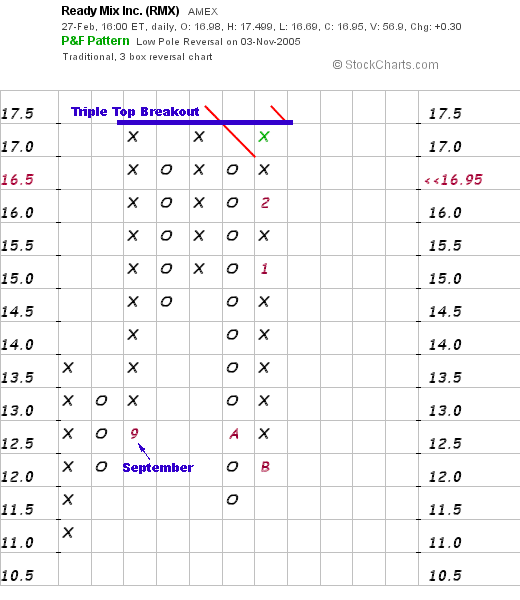
Ready Mix (RMX) was a stock that we started to target after the IPO last fall. We posted a case study on the member’s section of MSW on 9/20/05 with fundamental analysis and detailed chart analysis. The most interesting piece of the chart analysis was the breakout area that we targeted in September of 2005:

September 6, 2005 (first daily screen appearance):
RMX – 15.78, new IPO that provides ready mix to construction projects near Las Vegas.

September 10, 2005:
RMX was mentioned on a Secondary watch list on the Weekly Screen

September 17, 2005:
RMX makes the official watch list on the weekly screen at $16.60… Here were our comments:
“Young IPO that was mentioned last week and studied this week. The breakout would be a move above $17.50 on above average volume.”

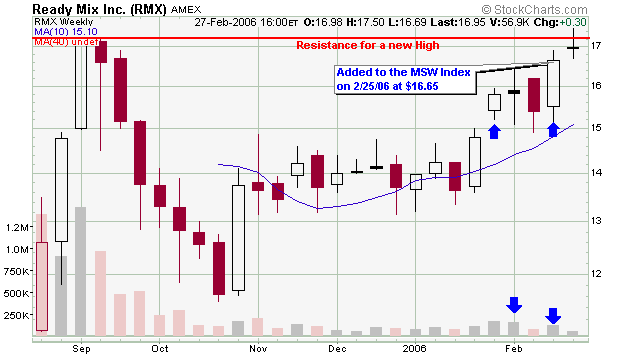
As we start to watch Ready Mix (RMX) once again, we have come up with the exact same breakout point that we targeted five months ago before the recent basing pattern. The buy was never signaled back in September and I am not sure if it will happen this time around either but it was not a coincidence that the stock reached $17.50 intraday today and then retreated during the afternoon hours.

Take a look at the three charts posted in this blog:
The first is a combo from September 21, 2005 as the stock was just debuting on the exchanges as an IPO from August.

The second chart is from today as the stock is about to complete a five month basing pattern with the EXACT SAME TRIPLE TOP BREAKOUT from September.

The third chart is the Point and Figure that has the chance for a triple top breakout (starting back in September).

If the stock breaks-out from this triple top breakout, I would have to believe that I was the first one to call the buy back in September 2005 (I am joking with this statement).

Ratings in September 2005:
EPS: 79
RS: 92
Industry Group: 40 out of 197

Ratings today (2/27/06):
EPS: 95
RS: 84
Industry Group: 66 out of 197
Piranha
Consider Timing when Buying a Stock

NutriSystem (NTRI) shares are up more than 13% today after the provider of weight-loss products beat Wall Street’s earnings expectations and offered a better-than-anticipated outlook. Last year, the company lost $605,000 or 2 cents a share in the fourth quarter. This year, the company posted a Q4 income of $6.3 million, or 17 cents a share, beating estimates by $0.01 as analyst were looking for earnings to come in at $0.16 a share. Revenue also jumped considerably from $7.9 million to $69.7 million (analysts expected $69.5 million).

Looking ahead, NTRI predicts earnings of $0.40 to $0.42 cents a share while analysts predict $0.37 (a main factor weighing into the 13% jump in earnings today). Company projections for revenue also come in higher than analyst’s projections ($122 - $127 million versus $117 million). This is the big difference between a stock like (NTRI) and (RNOW). RNOW also crushed earnings a couple of weeks back but the future expectations came in lower than analysts projections so the stock did not breakout. For further analysis on the RNOW failed breakout, see this blog post.

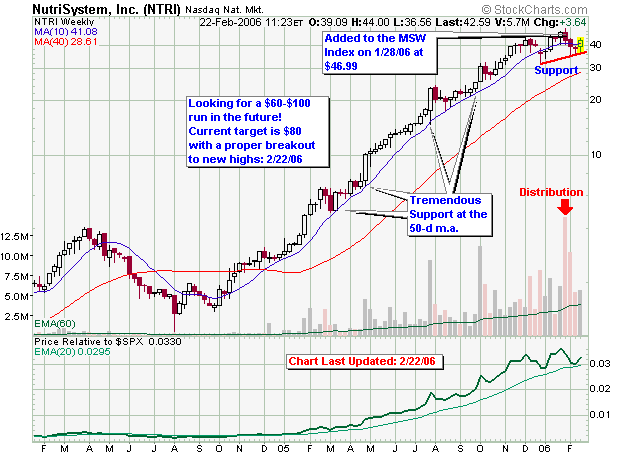
On 1/28/06, I added (NTRI - $46.99) to the MSW Index and said this:
“Added to the Index after it broke out above $45. The stock traded sideways for nine weeks in what I call a consolidation. It reminds me of HANS and TS when they made their great runs from the single digits to $100 per share. Target is $80 in six months.”

Two weeks later, the stock violated the MSW Index 10% mandatory sell rule so it was removed officially from the Index BUT I said this and kept it in it’s spot on the Index (unofficially as a watch candidate):

Analysis from Weekly Screen on 2/11/06 (NTRI - $38.95):
“The stock was a sell for anyone that bought at the former levels but I am not convinced in removing it from the Index because I see some support. Technically it is removed from the MSW Index as I have removed the date and % gain/loss. It has a chance to officially re-enter the MSW Index if it sets up another buying opportunity.”

This past Saturday, I went on to support my original feeling that this stock was receiving support and I may still be wrong but today’s 13% jump supports my original analysis:

Analysis from Weekly Screen on 2/18/06 (NTRI - $38.96):
“Down a penny this week as I will allow the stock to stay on the MSW Index as a watch candidate (not a buy candidate at this time). Some investors actually look at this stock as a shorting candidate and they may be right but I am not in that boat right now. I still see the possibility of a move higher after this sideways correction phase is over. Time will tell (for now – watch from the outside).”

What is the moral of this post?

Sometimes you may find a stock and research it and discover that it has upside potential and buy but get in at the wrong time. You may be forced to sell but that doesn’t mean that your original analysis was wrong. Don’t give up just yet, hang tight, take the small loss and watch the stock on the side to see if your timing was wrong. If the timing was wrong and the stock is acting strong again, place another position and follow the rules (especially your sell rules). If it violates the rules again, sell for another small loss. If it takes off and shows a profit, you will be very happy that you didn’t miss out on a big winner because your first trade was placed at the wrong time.

Over the next few weeks and months, we will see if NTRI will make the next run I originally anticipated!

Piranha

Position Sizing Examples (Simplified)

Question on Blog:

Hey Chris,

This post is great. It has really helped me to comprehend the concepts of risk management. I had one question though. Do you advocate holding relatively few investments (5-8) or more? I noticed that in the example with the $100,000 portfolio, the amount of capital used on a single position was $4,000. This would equate to roughly 25 positions in all. Do you think it would be smarter to invest more capital in fewer positions if you are only starting out with, say, $5,000-10,000?

My Answer:
What the reader is saying is only true to a certain degree. Let me show you several examples of buying the same stock with a 7%, 15% and 25% sell stop in place with two different size portfolios. The number of shares change but the risk stays the same.

In the first set of examples I will use $10,000 and then $5,000 for the second set of examples. In these examples, I will use the simplified approach discussed by Brian Hunt from my first post. Please note that these examples don’t consider other variables such as slippage, etc. Please read the book by Van K. Tharp to study the detailed models of position sizing. I will also note that it is very difficult to employ this position sizing strategy with only a $5,000 stake. In my own experiences, I only bought one or two stocks when my portfolio was starting out with less than $10,000. Besides, I didn’t know about position sizing ten years ago!

Example #1:
Stock XYZ is trading at $25 per share
Portfolio size of $10,000
Risk Model of 3% per trade (due to a small account)
The stop loss is 7%

Risk will be $300 = ($10,000*3%)
Amount to Trade at 7% stop: $4,285 = ($300 / 7%)
Shares to be bought: 171

Example #2:
Stock XYZ is trading at $25 per share
Portfolio size of $10,000
Risk Model of 3% per trade (due to a small account)
The stop loss is 15%

Risk will be $300 = ($10,000*3%)
Amount to Trade at 15% stop: $2,000 = ($300 / 15%)
Shares to be bought: 80

Example #3:
Stock XYZ is trading at $25 per share
Portfolio size of $10,000
Risk Model of 3% per trade (due to a small account)
The stop loss is 25%

Risk will be $300 = ($10,000*3%)
Amount to Trade at 25% stop: $1,200 = ($300 / 25%)
Shares to be bought: 48

Now I will change the parameters to a 2% risk model with $5000 in the account:

Example #1:
Stock XYZ is trading at $25 per share
Portfolio size of $5,000
Risk Model of 2% per trade
The stop loss is 7%

Risk will be $100 = ($5,000*2%)
Amount to Trade at 7% stop: $1,428 = ($100 / 7%)
Shares to be bought: 57

Example #2:
Stock XYZ is trading at $25 per share
Portfolio size of $5,000
Risk Model of 2% per trade
The stop loss is 15%

Risk will be $100 = ($5,000*2%)
Amount to Trade at 15% stop: $667 = ($100 / 15%)
Shares to be bought: 26

Example #3:
Stock XYZ is trading at $25 per share
Portfolio size of $5,000
Risk Model of 2% per trade
The stop loss is 25%

Risk will be $100 = ($5,000*2%)
Amount to Trade at 25% stop: $400 = ($100 / 25%)
Shares to be bought: 16

Piranha

Position Sizing & Risk Management

One of our fellow MSW community members wrote a great article on his blog about position sizing and I wanted to bring it to everyone’s attention:
Risk Management - Position Sizing

His main page can be viewed at:

Trend Following with CANSLIM

Since I am on the topic of blogs, I have been meaning to invite the community to read Jon Tait’s blog, Fickle Trader, someone I have formed an “investment relationship” with over the years. We met on the Richdad forums and have kept in touch ever since (we have some great conversations through e-mail about trading). He may refer to me as his mentor (way too much flattery) but I am sure he will be mentoring many more than I in the future while making (trading) his millions in the market.

Below is another simplified example of a specific position sizing method (for further reading on the subject, visit the book by Van K. Tharp that I mentioned on a recent post titled Sound Money Management Key in Trading:

Example:
Let’s say you have $100,000 to invest and you’re using the 1% risk model to guide your investments. If you’re using a 25% stop loss, you could buy $4,000 worth of stock and risk $1,000 ($1,000 is 1% of $100,000).

In the example above, you placed 4% of your portfolio into the stock and set a 25% stop—risking just $1,000 of your money (since $1,000 is 25% of $4,000).

Some investors use even tighter stops, in the 10%-15% range.

If you’re using the 1% risk model with a 10% stop loss, you could buy $10,000 worth of stock. You have the same dollar amount at risk ($1,000) as the first example - but you’re allowing the stock less room to go down before you sell.
Written By: Brian Hunt

Piranha
p.s. - keep in mind that the markets are closed today!

Question about Earnings (GES)

MSW Member Question:

Hi Chris,

My name is Joe and I am a member of MSW. I have a question that I really don’t understand. I am currently holding Guess (GES) and today it has an earning CC saying earnings beat estimates by 0.08/share. However, the stock dropped 10% with 800% more volume than average. The same situation happens to LMS where it dropped 20% with great earnings. Is there something wrong with the report that I have to pay attention to? Thanks for the advice.
(Actual member’s name has been changed for privacy)

My answer:

Two things you need to understand:

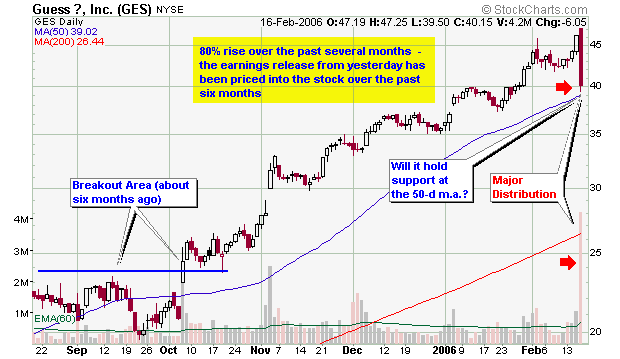
  1. Current stock prices reflect actual or anticipated news and earnings from the past six months so the great earnings release today was already priced into the stock.
  2. Future expectations and earnings will be priced into the stock today after the release based on the projections. All future moves of this stock will be based on the expectations at the next earnings release (essentially, the stock price is foreshadowing the price six months from now).

In the case of your stock, Guess (GES), it crushed earnings:

Q4 EPS Increased 73% Versus Q4 Last Year, $0.57 Versus $0.33
2005 Net Earnings Doubled Over 2004, $58.8 Million Versus $29.6 Million

Fourth Quarter Highlights
- Net revenues increased 23.5% to $276.6 million
- Comparable store sales up 15.9%
- Gross margin increased 310 basis points to 42.6%
- Earnings from operations up $17.3 million to $43.4 million
- Net earnings increased 74% to $25.8 million

2005 Highlights
- Net revenues increased 28.4% to $936.1 million; comp store sales up 9.2%
- Gross margin increased 310 basis points to 40.7%
- Earnings from operations reached $101.8 million
- Net earnings doubled to $58.8 million

Sounds great, right? WRONG. These numbers have already been priced into the stock. The stock broke out about six months ago above $25 as shown on the chart above. That was the proper time to get into the stock as it was trading on future expectations. Stocks move ahead of the news and not on the announcement of the news unless it’s extremely positive or negative (or a complete surprise).

Thursday’s 13% drop represents future expectations of the company and not the earnings that were released yesterday (again- they have been priced into the stock over the past six months). Here is the culprit of the recent drop in price:

LOS ANGELES, Feb. 16 /PRNewswire-FirstCall
Guess? Inc. today reported record financial results for the fourth quarter and fiscal year ended December 31, 2005. Net revenue and net earnings for the quarter and the year were at their highest levels since the Company went public in 1996.

Guess Inc. shares declined Thursday after the jeans and fashion retailer warned of moderated first-quarter sales growth. Stock of the Los Angeles-based company fell $6.05, or 13 percent, to close at $40.15 in heavy trading on the New York Stock Exchange.

For the first quarter, Guess expects same-store sales, or sales at stores open a year or more, to rise 10 percent. The company expects overall sales to rise in the mid-teen percentage range, a slower rate of growth than in the last couple of quarters.

Wall Street had expected revenue of about $249.6 million, about 16 percent higher than revenue of $215.6 million in the prior first quarter.

On a conference call, Chief Operating Officer Carlos Alberini noted the snowstorms in the Northeast and the occurrence of Easter in April in 2006, rather than in March a year earlier, would hurt comparisons.

For the month of March, for example, Alberini expects same-store sales to be “nearly flat,” according to a transcript provided by Thomson StreetEvents. For the second quarter, the company expects same-store sales growth of 10 percent.

******************
As you can see, the current price drop reflects future growth and expectations and they seem to be flat so investors grabbed their profits and ran. The stock did manage to close above the 50 day moving average and it will be interesting to see if it holds support above this line (it has since the breakout above $25). The minute investors heard that the stock will not meet analysts expectations, they sold and ignored the great news from last year because they know that those profits have already been made.

An old Wall Street saying goes like this:
“Trade the rumors and sell the news”

Six months ago, the rumor was that this company was going to beat earnings expectations so investors started to buy. Now the rumor states that they won’t beat expectations, so they sold the news!

Piranha

Next Page »