Blogging to the World Series of Poker

As many of you know, I love the market, I love writing and I love poker. In addition to writing on this blog, I write market analysis and provide equity research five times a week on MSW. To my delight, I went to play a sit-and-go no limit hold’em game tonight and saw an advertisement link to a free tournament sponsored by PokerStars for all types of bloggers. I use PokerStars.com exclusively and can recommend them to anyone interesting in playing online.

Here are some details from the PokerStars website:

PokerStars is proud to announce the 2nd Annual World Blogger Championship of Online Poker (WBCOOP). This is an exclusive FREE poker tournament open ONLY to Internet bloggers.”

“To prove our continued commitment to the bloggers of the world, we’re giving away a $12,000 package to the 2006 World Series of Poker. This package includes a $10,000 buy-in to the main event, hotel accommodations, and additional spending money. Imagine blogging your WSOP experience live from Las Vegas! You’ll have endless blogging material, a shot at being on TV, and a chance to win millions of dollars.”

“…you do not need to deposit money in your PokerStars account or provide any financial information in order to play in the World Blogger Championship of Online Poker event. Yes, it’s absolutely free!”

Each blogger in the poker tournament will start with 2,000 chips.
Blinds will start at 10/20 and will go up every 15 minutes.
Prizes will be awarded based on placement in the tournament.

Good Luck to all that enter!

I will be there using my wife’s screen name for good luck!

Piranha

Online Poker

I have registered to play in the PokerStars World Blogger Championship of Online Poker!

This Online Poker Tournament is a No Limit Texas Holdem event exclusive to Bloggers.

Registration code: 9433662
Hedge Funds - Richest of the Rich

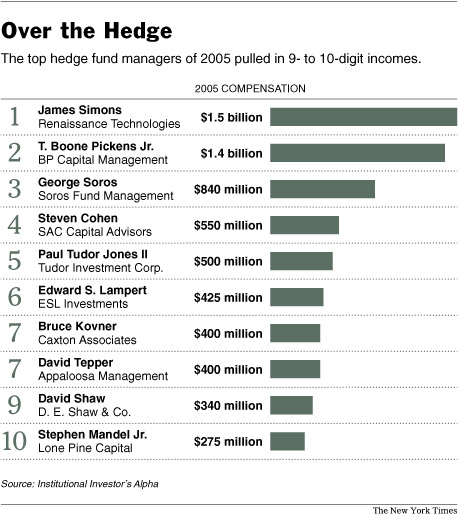
It’s good to be back from vacation and refreshed after following the weak market over the month of May. As I was away, The New York Times was delivered to my door each morning (complimentary) and I found an interesting article. I have always been amazed by the enormous incomes that hedge fund managers produce year in and year out. I have even posted up the top 10 salaries from past years (example: Top Incomes in 2003 for Hedge Fund Managers ). If you briefly view the top 10 from 2003, you can see that George Soros was #1 with a take home pay of $750 million. Well, only two years later the top earner has doubled the total from 2003 to a whopping $1.5 billion (eclipsing last year’s top earner by $500 million). Edward Lampert was the first manager to surpass the billion dollar mark in 2004 but two men accomplished the feat last year. One of my favorite traders, Steven A. Cohen remained in the top 10 with a salary of $550 million. Mr. Cohen, along with several others on the list below has been featured in the book series titled: Market Wizards (all highly recommended). Below is the entire article from The New York Times written by Jenny Anderson (originally printed on May 26, 2006):

Enjoy, the numbers are staggering!

Atop Hedge Funds, Richest of the Rich Get Even More So
By JENNY ANDERSON

Published: May 26, 2006
*image from The New York Times website*

Talk about minting money. In 2001 and 2002, hedge fund managers had to make $30 million to gain entry to a survey of the best paid in hedge funds that is closely followed by people in the business. In 2004, the threshold had soared to $100 million.

Last year, managers had to take home — yes, take home — $130 million to make it into the ranks of the top 25. And there was a tie for 25th place, so there were actually 26 hedge fund managers who made $130 million or more.

Just when it seems as if things cannot get any better for the titans of investing, they get better — a lot better.

James Simons, a math whiz who founded Renaissance Technologies, made $1.5 billion in 2005, according to the survey by Alpha, a magazine published by Institutional Investor. That trumps the more than $1 billion that Edward S. Lampert, known for last year’s acquisition of Sears, Roebuck, took home in 2004. (Don’t fret for Mr. Lampert; he earned $425 million in 2005.) Mr. Simons’s $5.3 billion flagship Medallion fund returned 29.5 percent, net of fees.

No. 2 on Alpha’s list is T. Boone Pickens Jr., 78, the oilman who gained attention in the 1980’s going after Gulf Oil, among other companies. He earned $1.4 billion in 2005, largely from startling returns on his two energy-focused hedge funds: 650 percent on the BP Capital Commodity Fund and 89 percent on the BP Capital Energy Equity Fund.

A representative for Mr. Simons declined to comment. Calls to Mr. Pickens’s company were not returned.

The magic behind the money is the compensation structure of a hedge fund. Hedge funds, lightly regulated private investment pools for institutions and wealthy individuals, typically charge investors 2 percent of the money under management and a performance fee that generally starts at 20 percent of gains.

The stars often make a lot more than this “2 and 20″ compensation setup. According to Alpha’s list, Mr. Simons charges a 5 percent management fee and takes 44 percent of gains; Steven A. Cohen, of SAC Capital Advisors, charges a management fee of 1 to 3 percent and 44 percent of gains; and Paul Tudor Jones II, whose Tudor Investment Corporation has never had a down year since its founding in 1980, charges 4 percent of assets under management and a 23 percent fee.

They may charge such amounts because they can. “In the end, what people want is the risk-adjusted performance,” said Gordon C. Haave, director of the investing and consulting group at Asset Services Company, a $4 billion institutional advisory business. “As long as the performance is up there, in the end the investors do not care about the high fees.”

If there is a downside to being so rich, it is that the money is flooding in at a time when hedge fund performance, even for some of the greats, has been less than stellar over all. Six managers made the top 25 even while posting returns in the single digits.

“You would think someone would be a little embarrassed taking all that money for humdrum returns,” said John C. Bogle, founder of the Vanguard Group. “I guess people don’t get embarrassed when it comes to money.”

Many of the funds have gotten so big that the management fees alone are the source of much wealth, perhaps leaving some managers without the fire to try to outdo the broad market. Institutions like pension funds and endowments, whose money is fueling a significant part of the hedge fund boom, continue to flock to these managers for their track records and name recognition.

Bruce Kovner’s Caxton Global Offshore fund returned 8 percent last year while his Gamut Investments, an offshore fund he runs for GAM Fund Management, returned 6.4 percent. The survey said 2005 was the third year that he had posted single-digit returns. Still, Mr. Kovner took home $400 million, according to the list. He did not return calls to his office.

The average take-home pay for the 26 managers in 2005 was $363 million, a 45 percent increase over the top 25 the previous year. Median earnings surged by a third, to $205 million last year, from $153 million in 2004.

Included on the list were both familiar names and new stars. Mr. Cohen of SAC Capital, who while shunning publicity has become known as an avid art collector, landed in fourth place in 2005, taking home $550 million. For the year, his various funds were up 18 percent on average. A spokesman for Mr. Cohen declined to comment.

New to the list are two managers from Atticus Capital, a fund that was among the investor activists that opposed Deutsche Börse’s attempted takeover of the London Stock Exchange for $2.5 billion. That campaign led to the ouster last year of the Deutsche Börse chief executive. Atticus is also a major participant in the battle for Euronext, the pan-European stock and derivatives exchange, which is being courted by the New York Stock Exchange and by Deutsche Börse.

Making his debut at 14th place, Timothy Barakett made $200 million in 2005. His Atticus Global Fund was up 22 percent net of fees, while the European Fund, managed by 33-year old David Slager (No. 20 on the list with $150 million), soared 62 percent. Atticus officials did not respond to requests for comment.

A fellow investor activist, Daniel Loeb of Third Point, made $150 million in 2005. According to Alpha, only 10 percent of the firm’s $3.8 billion is dedicated to activism, an unexpectedly small slice considering his reputation as management’s worst nightmare.

A value- and event-driven manager, Mr. Loeb posted returns of 18 percent, largely from bets in energy, including a 140 percent gain on McDermott International. Mr. Loeb’s spokesman declined to comment.

Another debut on the list was by William F. Browder, founder and chief of Hermitage Capital Management and the largest foreign investor in the Russian stock market. He tied for 25th place by taking home $130 million.

Mr. Browder, 42, grandson of Earl Browder, onetime leader of the Communist Party of the United States, has been barred from returning to post-Communist Russia since November, when immigration officials revoked his visa. The fund had $4.3 billion under management and in 2005, his flagship Hermitage Fund was up 81.5 percent.

A shareholder activist, he has challenged management at Russian state giants including Gazprom and Lukoil. Mr. Browder could not be reached for comment.

Dooms-day? Is this really 1987 all over Again?

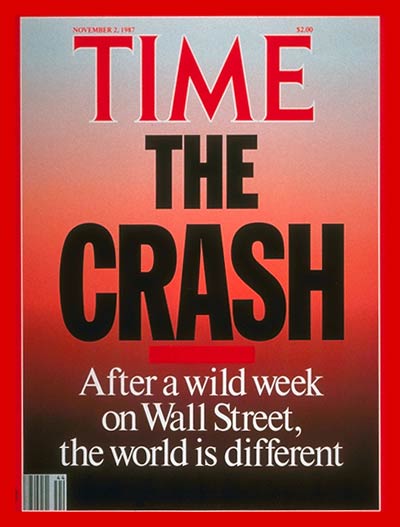
With the markets heading lower once again, I am sitting here with a big grin on my face as I start to pack for vacation. Why am I grinning? I have been scaling out of the markets over the past several weeks and have been advising all MSW members to do the same. My indicators have been turning very weak and the NH-NL ratio has been predicting this type of collapse all year long. As the markets neared multi-year highs and all-time highs, the NH-NL ratio stayed weak; a clear sign that we were watching a false move. I don’t expect to see a magazine cover similar to the Time image I uploaded any time soon but I may be wrong(from November 1987).

I highlighted some key quotes of mine on this blog from the MSW screens in May which show you how serious I thought this decline could become. It is a coincidence that I am leaving for vacation and the markets are so weak but it works perfectly for capital preservation. I am not worried about a thing because I have moved to sidelines and will enjoy time in the sun with my family as some people continue to average down and pull their hair out (trying to predict bottoms).

Now I will post up a “dooms-day” article that was featured on The Drudge Reportand has now been uploaded to many blogs and financial sites around the web. It is an interesting article from the London Times. A simple look anywhere online or in print will show you how investors are panicking. Gloomy articles are being written by the minute. Enjoy!


The Sunday Times May 21, 2006

Markets ‘are like 1987 crash’
David Smith, Economics Editor

CONDITIONS in the financial markets are eerily similar to those that precipitated the “Black Monday” stock market crash of October 1987, according to leading City analysts.
A report by Barclays Capital says the run-up to the 1987 crash was characterized by a widening US current-account deficit, weak dollar, fears of rising inflation, a fading boom in American house prices, and the appointment of a new chairman of the Federal Reserve Board.

All have been happening in recent months, with market nerves on edge last week over fears of higher inflation and a tumbling dollar, and the perception of mixed messages on interest rates from Ben Bernanke, the new Fed chairman.

“We are very uncomfortable about predicting financial crises, but we cannot help but see a certain similarity between the current economic and market conditions and the environment that led to the stock-market crash of October 1987,” said David Woo, head of global foreign-exchange strategy at Barclays Capital.

Apart from the similarities in economic conditions, during the run-up to the 1987 crash there was a sharp rise in share prices worldwide and weakness in bond markets, Woo pointed out. “Market patterns leading to the crash of 1987 resemble the markets today,” he said.

Equity markets settled on Friday after sharp mid-week falls, with all the main American stock-market measures recording small gains on the day. But nerves remain.

Gerard Lyons, head of research at Standard Chartered, said: “The volatility is explained by tighter liquidity conditions, markets pricing in more for risk and dollar vulnerability. But people forget that this is not a case of emerging-market economies being in trouble as in 1997-8. They’re in good shape.”

The vulnerability of stock markets is likely to add to the case for a prolonged pause before the Bank of England hikes interest rates, analysts believe.

While one member of its monetary policy committee (MPC) voted for a rate hike earlier this month, some recent data, notably subdued labour market conditions, suggest few signs of inflationary pressure.
Base rate is unlikely to rise until next year, according to a survey of analysts by Ideaglobal.com, a financial-research consultancy. It finds a median expectation that the rate, currently 4.5%, will rise in February next year.

Piranha

Commission Fees water down Expectancy

I have talked about position sizing and I have talked about expectancy.
If you understand the proper positing sizing algorithms and positive expectancy, you would think that you are on the road to riches or at least to a system that returns a profit. Not so fast! What happens when commissions start to eat away at the profits you thought you would have at the end of the year? Many investors have a winning system with a positive expectancy but that might not be profitable in the end when adding in the heavy toll of commissions.

As I have stated in previous posts, expectancy will tell you if your system will be profitable over time but you must use a position sizing calculation in order to trade the proper amount or you could be broke before you know it. Trading too large will send you to the poor house on your first or second major mistake. You don’t want to dig yourself into a hole you can’t climb out of with a positive expectancy system. It would be a sin to have developed a positive expectancy system, only to be ruined by commissions.

I am not a day trader although I continue to see advantages each and every day as I learn more about many of the advanced techniques of professional investing. Under my current system of investing (call it trend trading, momentum trading or swing trading), I pay a commission of $9.95 on each end of the trade (I rarely use limits but they cost a few dollars more on each end). That is cheap in my estimation but the more I increase my activity, the higher my costs become and the lower my expectancy becomes when adding in this major factor. Besides, I don’t have the advantage of using 4-to-1 margin the same way a day trader can leverage their account and position sizing algorithm. Day traders typically pay commissions per share rather than paying on each end of a “total trade”. From what I understand, this breaks down to a much cheaper structure as long as minimum trading levels are reached. If these levels are not reached, penalties may be applied but check with your own broker before you take my word for it.

I typically place the entire trade when I get a signal and use retracement stops to get out of a position to capture gains so I am only required to pay commissions once on each end. In tough markets, I will place tester buys but I also understand that my commission fees will accumulate due to the fact that I scale into the position and sometimes scale out. If I only place 1/3 of my anticipated position on the breakout in a weak market, my $20 round trip commission could accumulated to $40, $60 or $80+ based on the number of scale-ins or scale-outs I use. Using my current style of momentum trading, I can handle these larger commissions because I am aiming to capture larger gains per trade than most day traders. I am looking for the 25% initial breakout gain that accompanies many CANSLIM type stocks. Looking forward, I am developing systems that trade more frequently so I can realize my calculated expectancy over a specific number of trades. Since my number of trades will increase and my individual profits per trade will decrease, I want to minimize my commission fees.

It is very important to factor in commissions when calculating your overall expectancy. If your expectancy is positive but only slightly, be wary that higher commissions may push this number into negative territory. Weigh all factors before implementing a system that looks good on paper but actually comes out negative and gives you no chance of winning over the long term. A negative expectancy system (including commissions) will make you go broke if you continue to trade it. Think of that casino analogy; gamblers will go broke playing the tables in Vegas because the odds are against them. They may make a few big scores but in the end, the casinos take it all! Trade a negative expectancy system and the markets will take it all!

I love the movie Casino and there is a scene in this movie when Robert Di Niro develops a plan to keep a high stakes gambler at the casino so he can continue playing (to give back the money he won by luck – he made a big score). Di Niro (the casino manager in this movie) knows that the shark will lose if he continues to play because math never lies and the game of baccarat has a negative expectancy geared towards the players. Again, this is why I play poker at the casinos (they get a rake but that is just a commission fee in my mind as the positive expectancy is based on me playing the odds)!

Piranha

Did the NASDAQ surprise you?

I wanted to share with everyone the analysis I posted up to MSW screens last night because it makes a firm point that some just don’t get! Some investors continue to be surprised - can’t help everyone!

MSW mid-week analysis (5/17/06 9:00pm):
I am extremely happy over the e-mails I received today, commenting on the expectancy post, from both MSW members and non-members. It means a great deal to see that so many people “get-it” and how a simple spreadsheet helps so many more get that “ah-ha” feeling. I am going to follow up that post with an answer to another question on expectancy tomorrow. I will continue to feed you these advanced strategies in stages so you can digest what I trying to convey.

Now, I don’t want anyone to write me an e-mail asking “what to buy” or “why is the market going lower”. Hey, if this is harsh, so-be-it because I can’t spell out the dangers in the market any more clearly than I have over the past two weeks. I have been uploading a red bold text warning that “NOW IS NOT THE TIME TO BUY” with the first portion reminding you about the ‘M’ in CANSLIM. I even provided a link to my article from last year on the ‘M’ in CANSLIM. If you buy in this environment, be prepared for days like today and be prepared to take heavy losses. When I slash the MSW Index down to 14 stocks, it’s for a very good reason: the market is WEAK! It amazes me that some people don’t “get-it” and must be invested at all times trying to pinpoint the bottom while searching for opportunities on the long side.

When my daily and weekly screens go blank or get slim in size, it is the best indicator to me that it is time to ease off margin, move to cash and entertain the idea of going short. When speaking about going short, you should start to analyze sectors or industry groups that are in late stage bases or contain stocks that are violating moving averages and support lines (simultaneously). To confirm the screens, the NH-NL ratio has tuned negative (the number one reason to stop placing long positions). I said this just last night after a period of strength among some of the recent leaders:

5/16/06:
“Even with the strength of our leaders today, I am still playing heavy defense due to the negative reading for the NH-NL ratio for the second day this week: 99-138 (74-241 yesterday).”

5/15/06 & 5/16/06:
“Tonight’s daily Screen is a pure Watch List looking for potential buy candidates in the future. The market health is weak so sit tight and brush up on your trading skills, system development and money management techniques.”

5/13/06:
“We have now witnessed six distribution days for the NASDAQ and four for the S&P 500 over the past month (clear signs of institutional selling).”

5/13/06:
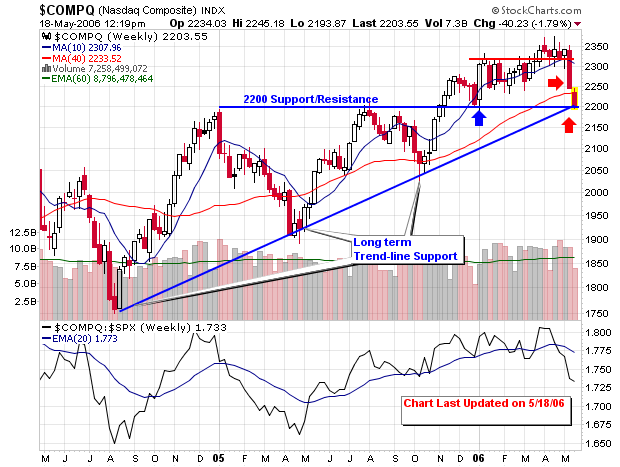
“Both the NASDAQ and S&P 500 have violated their 50-d moving averages as the NASDAQ fell over 4% to close slightly higher than its 200-d m.a. The Index has closed at its lowest level since the turn of the New Year. If it violates its 200-d m.a., I see it traveling down to the long term trend-line that started in the summer (July) of 2004.”

5/17/06:
The NASDAQ is now trading below the 200-d m.a. and is sitting on the long term support line that dates back to 2004. Violating this trend line will be a major red flag.

5/13/06:
“Unless you are a day trader, I advise that you take some time away from the markets and regroup. I am going on a mini-trip over Memorial Day weekend and I suggest that everyone else take some time to enjoy other things or at least take a small break from trading (especially since our market environment has turned negative).”

5/13/06:
“The MSW Index is now going through some of the most dramatic changes in over a year. If you want me to post “buy candidates” then you don’t understand how the markets work. I am sorry but now is not the time to be buying (in my opinion) based on all of my indicators.”

5/13/06:
“The leaders are getting crushed and the NH-NL ratio is declining with a negative day on Friday.”

5/10/06:
“As we start to hit this stretch, follow the rules and never break a stop loss (it might even be time to take a break and enjoy the sun)!”

To top off all of these quotes, I wrote an extensive analysis last Saturday documenting the six month period between May and October (focusing on the weaker summer months since 1950). I showed you how stocks start to take breathers and decline during the months of May and June.

The DOW came within 80 points of its all-time high last week but we are traveling different waters this week as the index is now trading below the 50-d m.a. for the first time since late January and early February. Today’s 214.28 drop on the DOW was the largest percentage drop since May 2003 (that month of May again). The index was down 1.9% on volume 22.9% larger than yesterday (clear signs of heavy distribution). Want me to sound crass? I was not hurt by the drops in the market over the past five days of trading and I am extremely proud. I use the arrogance to help get the message into everyone’s head!

The NASDAQ is now showing a 0.4% loss for 2006 and is 7.6% from its 52-week high. The NASDAQ 100 is now 3% below the 200-d m.a. as 191 of the 197 industries tracked by IBD closed lower today (many on increased volume). The seven distribution days over the past four weeks should be sounding alarms to protect your capital. The NH-NL ratio closed at 56-250 today, continuing the streak of negative ratios.

REMEMBER THE ‘M’ IN CANSLIM! NOW IS NOT THE TIME TO BUY!!!
The ‘M’ in CANSLIM:

Take a look at the Industries that fell the most today (do they have something in common):

Copper
Aluminum
Steel & Iron
Gold
Oil & Gas Drilling & Exploration
Industrial Metals

*No new stocks will be screened tonight for good reason – I hope you get the point*

Piranha

Next Page »