Listen to Martin “Buzzy” Schwartz The Interview

I found an interesting interview of Martin “Buzzy” Schwartz while searching the web last night. It is provided by a site named annonline.com and can be found through this address: The Interview

I mentioned that I read the book Pit Bull: Lessons from Wall Street’s Champion Day Trader by Martin Schwartz over my last vacation and enjoyed it very much since it is very different than most stock market books. He tells his story and gives some advice at the same time but I viewed the read as entertaining and extremely insightful.

I enjoyed the interview even though I would have asked different questions so now I want to share it with you. First I will recap some important facts that I wrote down while listening:

I believe the interview took place in the summer of 1998 prior to the 2,000 point drop on the DOW in the fall of that same year. The October 1998 low near 7,300 pushed towards a record high just below 12,000 in January 2000.

He mentions that the DOW is trading near 9200 during the interview and says “I have trouble understanding how we can march unabated.”

The market is “selling at 5.3 times book value – record high…”

This great trader knows that things are not right and that the market is overdue for a correction but he specifically states that you must follow the trend and avoid picking a top. This is supreme emotional and psychological control by one of the best traders of our generation.

He is quoted as saying: “Don’t fight the trend despite the fact that we are at historical highs.”

Buzzy goes on to say “we are at the high end of the valuation spectrum” and “difficulty is that we can be hit with something from left field and we are overdue for that.”

As a trader and not an investor, he points out that the market was better suited for his style of trading during the 1980’s when it moved back and forth (taking advantage of the long and short side). He doesn’t like the constant push higher that everyone witnessed in the late 1990’s.

He talks briefly about his methods and says that he’s not in the business of giving advice and doesn’t feel comfortable giving advice to other traders. But, he mentions that he uses a 10 day exponential moving average with red light and green light signals (above the moving average is a positive green light and below is negative or a red light).

He uses his own type of money management with a risk parameter set in dollars. He will cut a trade when the dollar figure is violated.

Ann goes on to ask him if he ever breaks rules and as expected (we are all human), he says yes and blames it on emotions and stubbornness.

As many traders already know, the bulk of your profits are made on a minimum number of days throughout the year. Schwartz says: “200 days per year are about even. About 50 days per year is where my big money is made.”

Ann asks him what’s the most he has made in one day and he responds: “several million”. At one point in the early 1980’s, he was making $70,000 per day trading the S&P’s. In 2006, $70,000 a year is still considered a good salary!

Finally, he talks a bit about setting up a plan and putting it on paper before quitting your job and aspiring to become a full time trader. There’s more detail in the interview and in the book so I’ll let you find out for yourself.

He ends the interview by answering this question:
Ann: Can anyone do what you have done?
Martin: “Few can do what I have done” “rare set of skills and honesty, along with intelligence”

Publisher’s weekly describes the book as such:
After working several years in what he considered to be a dead-end job as a financial analyst at E.F. Hutton, Schwartz quit the firm, accumulated a nest egg of $100,000 and on August 13, 1979, bought a seat on the American Stock Exchange where he began trading stocks, options and futures. He quickly became an expert at trading S&P futures, and in his first full year as an independent trader made $600,000 and a year later earned $1.2 million. Schwartz’s style was to get in and out of positions in a hurry; he rarely held on to any financial instrument for more than a day. As his success on Wall Street grew, he began his own fund in which he would manage other people’s money as well as his own, a move he would regret. The stress of running the fund contributed to his developing pericarditis, which nearly killed him. His doctors advised him to slow down his lifestyle, so at the age of 48, Schwartz, along with his wife and two children, moved to Florida where he took up golf and developed a daily routine that allowed him to keep trading, but at a more relaxed pace. This is one of those rare autobiographies where the subject unintentionally portrays himself in an unfavorable light. As he grew ever richer, Schwartz became consumed with generating even more money and prestige so that he could “run with the top dogs.” Inadvertently, he has written a cautionary tale on the dangers of being addicted to money and power.

Piranha

Listen to your System

As I highlighted in the blog post yesterday, my system alerted me that the market was going to take a turn south in the summer of 2004 and it did (May, June and July). It is important for every trader to have your own system that alerts you of moves which allows you to profit. It can be short term, long term or anything in between but you must understand what it is saying. I depend on the price and volume of the major indexes, the NH-NL ratio and the action among the individual leaders to determine if the market is strong or weak. Since I have studied these patterns for years, I know when the market is moving higher or lower based on the confirmations each of these indicators give me. Nothing is exact but they are extremely accurate as they guide me with test buys, position sizing my trades and moving me to the sidelines.

Take a look at how these three major indicators got me in and out of the market in 2004 (and keep in mind that I am not a day trader – I was momentum trading, trend trading and swing trading in 2004 – which ever you would like to call it).

I wrote this entry on my Weekly Screens on April 19, 2004 (the highs on the NASDAQ in April 2004 were not revisited until November of that year):

Market Overview: The market is still in a confirmed rally according to rules but we are seeing many stocks hesitate and undecided about their direction. The world situation has been a big influence on the general market conditions. Speculation of an interest rate hike has kept the market in flux.

My screens showed bad news last week with the daily new highs and lows. For the first time since posting my screens in November (2003), the daily new highs were lower than the daily new lows. I haven’t seen action like this since the bear market.”

I posted a weekly screen insert in yesterday’s blog post from July 2004 which warned that the market was still heading lower. The MSW screens turned negative in May 2004 and stayed that way until late August 2004 as you will read below.

WEEKLY OVERVIEW of 8/16/04 to 8/20/04:

“…However, I am possibly seeing a new trend that may be starting to form in the indexes. You heard it here first. I may be early but I am seeing a change in my screens. (Please note, I saw the trend in March of 2003, especially April of 2003 – I posted in real time on this breakout simultaneous with IBD). I was tipped off by the “new highs vs. new lows” combined with the huge institutional sponsorship that was sending stocks to new highs.

The DOW was up just short of 3% from Friday (13th) to this past Friday (20th)
The NASDAQ was up 4.5% in the same time period
I have noted that volume was extremely weak.

The New Highs vs. New Lows picture looked different than past weeks.
We had 3 days out of 5 that had more new highs.

On 8/13, we had – NH-37, NL-304
On 8/20, we had – NH-128, NL-53

I know this is minor but it may be the first signs of a changing atmosphere. Stayed tuned as I will keep a close eye on this change in my screens. (I have done my daily analysis for Monday, August 23, and I see more encouraging signs in the NH vs. NL list: 131 vs. 46). Again, volume was weak. When the charts and volume cooperate with the new highs list, we may be half way to a new up-trending market.”

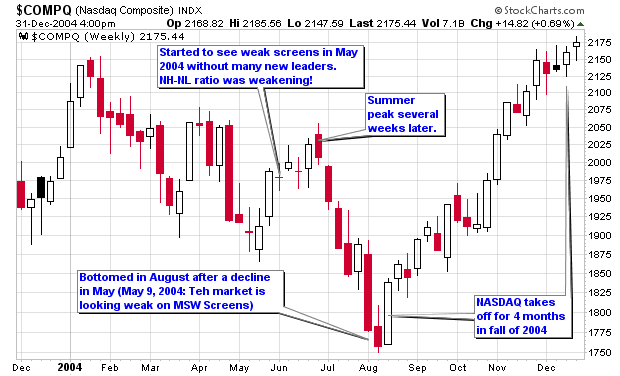
Looking at the chart from 2004, I guided traders out near the top of the early summer decline and I guided them back in at the beginning of the late summer/ fall advance.

More recently, I took investors out of the market in mid May 2006 and hope to have them back in when my screens confirm the rally in the future. When will that be? I don’t know but my research will tell me as it has every time in the past.

If you would like to review my work on the MSW screens, I invite you to explore my past archives from 2004 and 2005 as they are open to the public. You can review a chart as you read everything I have written over the past two years. The archives for 2006 are for members only but will open to the public when the year ends. Using my three main indicators, I have been very successful by getting in and out of the market since late 2002. Prior to 2002, my system was not as strict as it is today but I learned my lesson by getting slammed in 2001.

Develop a system, hone that system and understand what it is trying to tell you and you will come out with a profit. Every trade can’t be a winner but you won’t be fighting the trend because your overall system will tell you what side of the market to trade.

Piranha

Déjà vu on the NASDAQ?

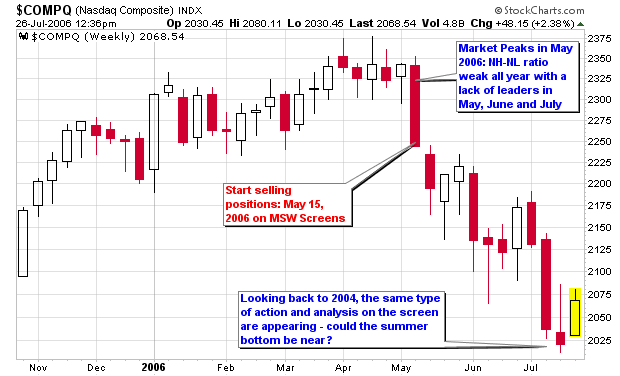
As I was researching my archives on MSW (the archives from 2004 and 2005 are open to everyone) I found some interesting data that correlates the NASDAQ in 2004 and 2006. So far in 2006, we have had 15 down weeks and 14 up weeks. At this time in 2004, we had 19 down weeks and 10 up weeks and the NASDAQ was at a nine month low (very similar to now as we are near 10 month lows). In 2004, my daily and weekly screens started to turn south on May 9th; in 2006, they started to turn south on May 15th (about the same time).

If you look at the two charts presented in this blog entry, you will notice how the market started to weaken in May and June and with a bottom near the end of July into early August. This summer is not over but I am wondering if the pattern will turn out to be similar to the one from 2004. The old saying: “sell in May and go away” has held up over the past couple of years with opportunities presenting themselves during the fall (towards the end of October).

Several of things I was saying back in 2004 are very similar to what I have been saying over the past two months. The similarities are amazing and the current NASDAQ chart may be forming a pattern that could take a similar route as it did in August of 2004. Only time will tell but history repeats and traders are always learning from history.

NOTE: when I say history repeats; I am not saying that it repeats exactly but the charts do resemble similar formations and seasoned traders and investors can capitalize on these situations.

Here is my exact analysis from July 2004, very similar to things I am saying today (2 years later).

“WEEKLY OVERVIEW of 7/19/04 to 7/23/04:

I am starting to sound like a broken record. The Dow was down for the 5th consecutive week. The NASDAQ is now at a nine month low.

Quote from IBD regarding the NASDAQ:
“Out of 29 weeks of trade this year, excluding the week ended Jan. 2, 19 have been down.”

I ran my screens this past week with a few stocks making some daily cut offs – barely. When I ran my final weekly screens last night, I came up empty. Not one possible candidate that legitimately makes my watch list. I must scratch my head when I see people listing dozens of stocks for potential buys in this type of environment.

Anyway, I have my own system and that is all I can talk about right now and this system is telling me to be patient, be very patient. Every red flag has been raised over the past 3-4 months.

Anyone that has followed my screens would have noticed that things were going south when I stopped posting individual stock lists after May 9th. How could I, quality stocks were not around. I would be doing an injustice to the people that follow my screens if I just posted any old crap for the sake of posting.

Now, let’s be patient – patience is one of the most sacred virtues of a stock market investor. Jesse Livermore once said: “It’s not your thinking that makes you money, it’s your sitting”.

Here are some insight about market corrections:
Market corrections are healthy, allowing it to breathe. Corrections allow stocks to shake out weak holders and allow stocks to form proper bases. Corrections allow stocks to resemble their actual value more closely. Market corrections and flat markets allow intelligent investors to study conditions carefully while they sit on the sideline patiently awaiting the defining trend. Money is made on the big moves, not the minor day to day moves. Corrections allow big moves to establish themselves.

During bear markets or general market corrections, it is essential to keep up your watch list as many future high flyers are building bases during these times. Stocks that correct the least and sport the highest relative strength lines tend to be the leaders of the next bull market. Take note of all stocks that are base building during corrections, a cup with handle or flat base are the most popular.

How can you spot a correction or bear market on the horizon
• The major indexes will advance on below average volume.
• Stocks making new 52-week highs will be limited.
• Stocks making new lows will increase.
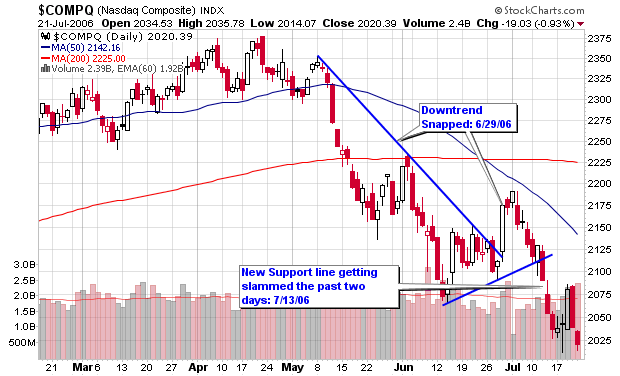
• Major indexes will fall below the 50-day MA and/or the 200-day MA.
• Index averages will start to under perform. Relative strength lines will head south.
• Major publications will tout hot stocks at key market reversals (market tops).
• Smart money will bail in huge volume. Down days on excessive volume above average.

NO STOCKS LISTED THIS WEEK, REFER TO PREVIOUS WEEKS”
-7/26/04

Just a note: I didn’t add any new stocks to the MSW index last week (7/26/06)!

Piranha

Ticker Sense Sentiment Poll

I want to draw everyone’s attention to the Ticker Sense Sentiment Poll since I am now a participant.

What is this poll?

The Ticker Sense Blogger Sentiment Poll is a survey of the web’s most prominent investment bloggers, asking “What is your outlook on the US stock market for the next 30 days?” Conducted on a weekly basis, the poll is sent to participants each Thursday, and the results are released on Ticker Sense each Monday. The goal of this poll is to gain a consensus view on the market from the top investment bloggers — a community that continues to grow as a valued source of investment insight. © Copyright 2006 Ticker Sense Blogger Sentiment Poll.

Justin Walters and Paul Hickey co-founded and developed Ticker Sense in the fall of 2005 in hopes of providing more and more individuals with the type of research that they produce at Birinyi Associates, a financial research and money management firm.

It will be interesting to see how accurate this poll will be moving forward as compared to other major polls. Most of the bloggers included would call the main stream analysts “talking heads” as I already do but are we becoming “talking heads” by developing this poll. I’ll say no for now! In any event, bookmark their blog because they produce excellent material.

Piranha

Ten Stocks to Watch

The NH-NL ratio finished at 97-182 on Thursday, staying on the negative side, reminding us that a rally is not taking place. Sellers continue to have their way with a 3-to-1 advantage during Thursday’s session as the NASDAQ gave back 2% (all of Wednesday’s gain) but volume was lighter. Staying on the topic of “large caps”, I noticed that Apple gained 12% after reporting bullish sales, Google fared better than Yahoo but is only up 0.49% heading into the final hour of trading on Friday (under both the 50-d m.a. and 200-d m.a.).

The S&P 100 Index/S&P 600 Small Cap Index that I track is up over 6% this week for its largest gain in years, confirming that large caps are moving to the head of the class. Investor’s Business Daily pointed out how CBOT (a stock I have highlighted on this blog in the past) blew past expectations but couldn’t gain much ground throughout the day after reaching a high of $126. The stock is actually down 3% today, telling us that buyers don’t have a chance, at least not now. The stock has formed a V-shaped cup with handle with a pivot point of $124.58 (breakout volume should reach 600k shares).

If the NASDAQ closes where it is right now, it will have its lowest close of the year (the lowest since May 2005). The S&P 500 index challenged its former support (now resistance) of 1,245 earlier in the week but looks set to close below this level within the next hour. Crude has dropped the past four days and attempted to climb back above $75 earlier in the day but looks like it too will close below former support (now acting as resistance).

So, are there any stocks out there to consider for a watch list?

Here are 10 to Take a Look at:

  • ADS – the stock has been falling for three straight weeks but I told MS members that this could be the case since it had to fill the gap from April, something it may be doing (down to $47.50). If it bases here (or gets support), I am buying several calls to speculate on my idea of a bounce.

  • GRMN – down over 2% for the week but the stock continues to hold the 50-d m.a. as support while maintaining a presence near the psychological triple digit threshold. I still like the stock in a rallying market (could make a nice option play for a solid run).
  • LVS – the stock is trading between a range of $65 and $74 (with some higher ticks) but it still sports a solid relative strength rating and solid fundamentals. The $60-$100 run is still a strong possibility
  • ZUMZ – trading in a range of $30 and $37.50 for the past 12 weeks with some minor intra-week movements above and below the major range. The most recent breakout of $36 was reversed but who can blame the stock in this type of market.

  • EZPW – filled the gap back down to $38 and is now trading between this level and the high above $45. I would consider this a handle to a longer pattern that could give us a nice run if the market were to breakout.

  • ARP – trading in a range between $32 and $39 for the past 18 weeks, all above the 200-d m.a. The stock has a supporting relative strength rating that suggests it can move higher in the next rally.
  • MAA – an 18 week base that has held up for the most part during the past two months as its relative strength rating continue to soar. A breakout to new highs is a buy point on the point and figure chart ($58).
  • ORB – the stock has been acting very well this week amid the negative tone among the other leaders and the major indexes. It managed to gain more than 5% during a weak of turmoil and it did so on heavier volume (above average). With the strong moves above $16, the stock is now slightly extended but one to continue to watch.
  • MED – the speculative stock that made us money earlier in the year is now forming a sideways consolidation base, one that has lasted for seven weeks. The support seems to step in near $16 with the weekly breakout above $20. Of all the stocks listed, this may become the best play for pure traders.

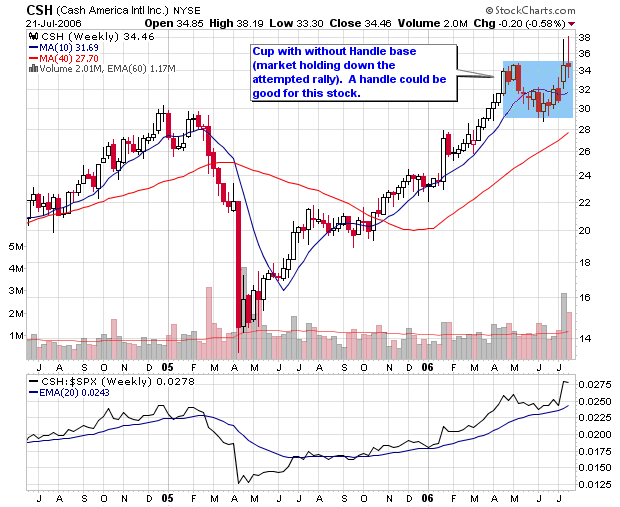
  • CSH – the stock has formed an 11-week cup shaped base without a handle. It attempted to breakout over the past two weeks but has not succeeded due to the weak market but this could be beneficial as it might form a proper handle. With today’s intraday low, the stock has basically filled the two gaps from earlier in the month.

Piranha

Next Page »