Google Blackstone Group (BX)

Blackstone was all the hype last week as the IPO priced at $31, shot up above $37 and then quickly tumbled to close below $30 the past couple of days.

What does this mean?

Well, the stock is new and many amateur investors probably got slammed the first couple of days with 20% paper losses but that shouldn’t scare longer term investors.

062807_bx_daily.png

Take a page out of the lesson book of Google (GOOG) and study how that stock also dropped quickly in the days after the IPO debut. The stock reached a height of $113.48 before dropping back below $98 eight trading days later.

Volume dried up as the stock retreated prior to the first major up-trend which blasted the stock above $140 within a month. History can tell the rest of the story as the stock now trades above $525 per share but that is not the point.

I am not saying that BX will be the next GOOG but it can give you some comfort that GOOG did drop and pause prior to making a run.

062807_goog_daily.png

Volume has been drying during the recent drop in BX so only time will tell if the stock can start its first true up-trend.

FYI: Keep an eye on the new legislation proposed by congress as it may affect the stock (BX) in the coming weeks and months.

I don’t have a true trend-trading rating on Blackstone but I would lean towards “Buy” over the longer term!

JASO Price Target is Hit

The 3.7-to-1 risk to reward ratio that was highlighted in Young Guns Taking Off was met yesterday as the stock is now 40% higher than my original entry point (only 11 trading days back). Now is the time to guarantee at least a 30% gain by placing a hard physical stop at $31.89 or near $32. The stock still has long term potential based on its recent price explosion and institutional sponsorship but a hard stop is my idea of comfort while sleeping. Our target was met and my goal was reached so I can’t be greedy! Remember this post: Don’t Be Greedy

Below is an insert from the June 20th Case Study:
Potential Trade Set-up:
The Ideal setup was last Wednesday at the moving average when I started coverage!

Ideal Entry area: $23 - $25 ($24.55)
Risk a maximum of 1% of portfolio (half of 1% would be better for this speculative play)
Set a stop loss above $22.00 (7-10% from entry – must be below 50-d moving average)
Target of $34+ based on recent swing action (stock is young for ideal target)
Risk to reward has a potential of 3.7-to-1 based on exact entry ($24.55) and stop of $22.

062807_jaso.png

This was the original blog post that highlighted JASO at $24.55:
Fresh IPO Ideas

JASO – JA Solar Holdings, Co. Ltd. - $24.55
Earnings Analysis:
$0.41 - Last Year Primary EPS
$1.00 - Current Year Mean Primary Estimate
$1.41 - Mean Primary Estimate — Next Year
30.00% 5-YEAR GROWTH MEAN EPS

Institutional Analysis:
Total Held by Institutions: 87
Money Market: 68
Mutual Fund: 18
Other: 1
Shares Held: 15.16 mil
Shares Held Previous Period: 1.85 mil
Shares Bought: 13.51 mil
Shares Sold: 0.19 mil
Value of Shares Bought: $314.6 mil
Value of Shares Sold: $4.58 mil

Shares bought versus shares sold is what really caught my attention! That is institutional sponsorship at its best. The risk-to-reward was excellent and quickly achieved by the powerful smart-money support.

NASDAQ and Crude Oil Combo Index

I am revisiting a combo index chart that I highlighted numerous times last summer as the NASDAQ started a new leg up since the bull market in 2003. I described the chart as such in a post titled Can the NASDAQ – Crude Oil Index predict Bulls & Bears in June of 2006:

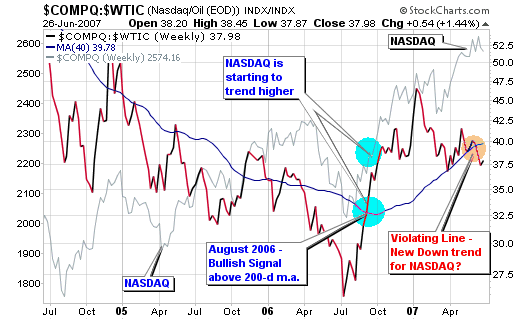
The chart is a combination index that I created using Stockcharts.com advanced tools. It combines the average close of both the NASDAQ and crude oil contracts over the past 10 years with a 200-d moving average. As you can see, the progression of this chart has called every major up-trend and downtrend before it was about to happen. The gray line on the chart represents the actual close of the NASDAQ index over the past 10 years (this line varies from the combo index).

062707_nas_crude_yrly.png

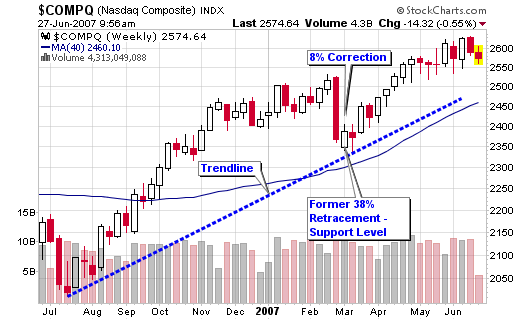
Viewing the current progression of the chart, we can see that the combo index is violating the 200-day moving average for the first time since last summer (August 2006) when the NASDAQ was trading about 20% lower than current levels. Looking back, the NASDAQ has always corrected, even slightly when the combo index crosses back below the 200-d moving average. Please see all red highlighted circle areas on the yearly chart. Our best idea of what may happen can come from the action back in late 2003 and early 2004. The NASDAQ made a multi-month consolidation before trending higher again.

The NASDAQ has gained more than 100% since the low in late 2002 and this is the first time since the bubble burst that the combo index is trading above the long term trendline (dotted black line) so things may be different this time around.

No one knows what will happen but I will remain cautious since this secondary indicator has been fairly accurate over the past ten years. Couple that with the fact that the NASDAQ is trading about 30% higher than it was last year at this time and the fact that crude oil is trending higher in a yearly cup shaped base. Many indicators scream correction but the market keeps trending higher. Price and volume will remain the primary indicator!

062707_nas_crude.png

This post, Will the NASDAQ be 50% higher in 6-12 months? details some more information about the mysterious combo index that I follow as a secondary indicator:

…The combo index highlighted the relationship of the two indexes and actually told us on a higher level when and where the market was making rallies or starting major down trends over the past 10 years.

062707_crude.png

I asked this question on August 23, 2006:
Will the NASDAQ be 50% higher in six to twelve month from this year’s bottom?

Well, it didn’t gain 50% but it did manage to tack on 30% - NOT TO SHABBY!

062707_nas.png

Position Sizing and Expectancy

So where does system development start?

Investors will be prepared to trade in situations when the odds are in their favor by properly understanding position sizing techniques and calculated system expectancies. A system that has been tested will have an approximate expectancy that will tell the trader how much will be gained or lost during each trade over a period of time. Using this knowledge, the investor will determine how much risk to undertake by calculating a position sizing algorithm which tells you how much to place on a specific trade. The word ‘algorithm’ sounds scary but I have developed very simple position sizing and expectancy spreadsheets that can be found through the links below. They can be downloaded, studied and tweaked without any advanced spreadsheet or mathematical experience.

Most traders look for three major factors when developing a system:

  • How much to trade on each position
  • The right odds or positive expectancy
  • Number of trades or how much opportunity the system presents

How do we Calculate Position Size?
We can determine how much to place on each trade by assuming a $100,000 account with 1% risk on each position. Using a basic trading approach, I will place my stops approximately 8% below the ideal entry area or pivot point. Please use more advanced methods for locating the ideal stop rather than a general 8% (I am doing this for example purposes only). Look for the ideal risk-to-reward setup based on recent support and resistance levels and set your stop and potential target accordingly.

$100,000 Account
1% Risk = $1,000
8% Stop Loss
Position Size will be $12,500

We calculate the position size by dividing the 1% risk by the 8% stop loss or $1000 / 8% = $12,500.

If the stock we are watching has an ideal entry of $50, we now know that we can buy 250 shares or $12,500 worth of stock. Our stop loss is $46 or 8% of $50 and our maximum loss is $1,000 of the original $100,000 portfolio.

What exactly is expectancy?
Expectancy tells you what you can expect to make (win or lose) for every dollar risked. Casinos make money because the expectancy of every one of their games is in their favor. Play long enough and you are expected to lose and they are expected to win because the “odds” are in their favor. Most games at a casino are completed in a short period of time so they can increase their odds of winning.

Read more »

Catch a Rising Star

My goal is to locate, research and trade the best growth stocks in the market but I can’t catch them all (most of you know that I love strong IPO’s). Take a look at the charts below as they represent four superstar IPO’s over the past two years. Unfortunately for me, I haven’t owned any of them to date!

Why did I fail to catch a rising star and buy these stocks?

  • Crocs, Inc. (CROX) was a personal thing (human nature at its best): I hate the look of those shoes!
  • Western Refining Inc. (WNR) was a pure miss. It started to cross my screens but I felt I missed the ideal risk-to-reward setup.
  • Energy Transfer Equity LP (ETE) was a ghost to my screens as far as I am concerned. I went back to look and it did appear a few times but I never highlighted it for further analysis.
  • J Crew Group Inc. (JCG) was screened on MSW last fall but I am not a fan of retail stocks. I skipped this sucker on purpose. That damn human thing again!

062507_crox_wkly.png

062507_wnr_wkly.png

062507_ete_wkly.png

062507_jcg_wkly.png

I hope some of you own/owned shares in these companies!

Next Page »