Trading Mistakes: Avoid at all Costs

Traders are human and we all make mistakes. However, successful traders learn from their mistakes and capitalize from their experience using their next opportunity. Many of the items listed below are obvious but are not known by novice investors and can be forgotten by experienced traders.

Common Mistakes to Avoid while Trading:

  • Failure to cut losses: Pride, ego, or stubbornness prevents the trader from selling.
  • Not knowing “how much” to trade on each position: Overtrading positions can kill your account and take you out for good (risk of ruin). (Learn to position size)
  • Average down in price: Placing good money after bad is a loser’s game.
  • Listening to rumors: Forget the talking heads, rumors and tips as they are nothing but garbage and a sure way to substantial losses
  • Lack of patience: It takes years to master trading as an advanced skill; even then, you are never done learning or adapting
  • Not knowing when to sell: Determine your price objectives and risk-to-reward ratios prior to entering the trade; never allow emotions to make this decision.
  • Buying 52-week lows: Don’t be afraid to buy stocks making new highs. The garbage sits at the bottom along with weakness and downward momentum. Buy strength and the momentum moving higher.
  • Pure Fundamentalist: Technical analysis is a must! Use candlestick charts that show the price, volume and major moving averages – this is all you need, don’t complicate the process.
  • Making trading decisions based on taxes: Never buy or sell based on taxes alone.
  • Buying based on dividends: Don’t buy based solely on dividends; most growth stocks will never give out dividends
  • Buying familiar names: Yesterday’s leaders are not likely to be tomorrow’s stars. Look for solid new companies with great earnings, sales and a product in demand. Don’t buy a stock based on a popular household name.
  • Lack of action: Be able to move on a dime. Time is money, don’t procrastinate or hope for something that may never happen.
  • Lack of Consistency: Develop a method suited to your personality; stick to it and don’t trade blindly.
  • Emotions: CONTROL EMOTIONS – RULES ELIMINATE EMOTIONS!

The secret to winning big in the market is not to be right all the time but to lose the least amount of money possible when you are wrong. As long as you win larger than you lose, you will become a consistent winner at the end of each year.

Share

Market Review and Links

I have an abundance of offline work that needs my attention so please enjoy the links below as they are of much value in the current market. Enjoy and see you tomorrow!

Share

Focus on Decisions, Not Outcomes

Six Secrets of Successful Bettors: Winning Insights into Playing the Horses, a book I randomly stumbled upon while walking through Barnes and Noble this weekend. Now, I haven’t read the book and probably won’t but the table of contents read like it was coming from the trading world (the two entities are very similar when run like a business). The six secrets discussed along with the titles of the chapters would be perfectly sufficient for an author writing a new book on trading.

The six secrets are:

  • Act as an entrepreneur not a gambler
  • Make the best use of available resources
  • Only bet when there is a significant edge
  • Manage bankroll effectively to maximize advantage
  • Know how to handicap yourself using effective record-keeping
  • Effectively handle emotions as well as money

Chapter Titles:

  • Chapter 1 – A Hard Way to Make An Easy Living
  • Chapter 2 – The Information Edge
  • Chapter 3 – The Never-Ending Quest for Value
  • Chapter 4 – If I Only Knew How to Bet…
  • Chapter 5 – Woulda… Coulda… Shoulda… Doesn’t Get it Done
  • Chapter 6 – It’s One Long Game
  • Chapter 7 – The Road Ahead: Issues Facing the Game

Charter six, It’s One Long Game, started with the title phrase of this blog post:
Focus on Decisions, Not Outcomes.

I quickly reminded myself how true this is when trading as too many investors focus on the short term results or the money won and lost in each trade rather than the net result.

The idea of the game is to make the right choices and understand that some of those choices will turn out to be losers. Losers are part of the game and must not affect you emotionally as long as the decision was correct. You must study, analyze and focus on your decisions, not on the amount of money won or lost on each individual trade. As long as your decisions are correct and consistent, you will be a winner over the long term.

Chapter six has been appropriately titled to translate to the trading world:
It’s One Long Game – GET USED TO IT!

On another note, I also started to read a book titled The Wolf of Wall Street while at Barnes and Noble and it had an interesting start but turned into a complete story about a scum bag from the late 1980’s and early 1990’s. I can only imagine what’s going on in the sleazy Hedge Funds of today. I put it down after I realized the guy was only interested in talking about Quaaludes, cocaine and ridiculous drinking. He scammed people out of tens of millions of dollars, cheated on multiple wives, admits he lied for a living and went to prison (he sounds very proud of the accomplishments mentioned). I feel bad for his children. He was in it for the short game – get rich quick! Loser is all I can say.

Share

Inverse ETFs Paying Off

The Inverse ETFs that I highlighted in October are really paying off with an average three month gain of 21%. I will admit that I didn’t buy any of them but I know several readers that were real excited about their potential and their ease of use.

012408_qqqq.png

Many traders are turned off by the complexities of shorting or just don’t feel comfortable about the process so Inverse ETFs present them with a simple solution. Trading Inverse ETFs allows traders to place an order that mimics the buying and selling process of a regular stock but you are now betting the short side instead of the long side. These trades allow the investor to ride the market down without the complexities or uncomfortable jitters of shorting.

As I wrote in October, Inverse ETFs are specifically designed to move in the opposite direction of the underlying market index. Thus, if the Dow Jones Industrial Average declines by 1 percent, its inverse ETF (the Short Dow 30 ProShares Fund, symbol DOG) will rise by 1 percent. When the S&P 500 falls by 1 percent, the Short S&P 500 ProShares Fund (SH) will rise by 1 percent.

Take a look at the gains of the four ETFs I highlighted prior to the market opening on October 17, 2007:

  • DOG: 17.47% peak gain this week
  • SH: 19.21% peak gain this week
  • PSQ: 22.83% peak gain this week
  • RWM: 23.07% peak gain this week

I don’t recommend jumping into these ETFs right this moment (the previous opportunity was in October when I presented them) but keep an eye on the market and look to pounce when the major indexes bounce higher and start to show overbought signs. Be patient just as you would with trades on the long side.

012408_dog.png

012408_sh.png

012408_psq.png

012408_rwm.png

Share

Cramer YELLED Buy, I wrote Sell

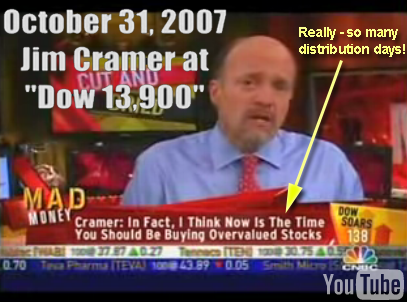
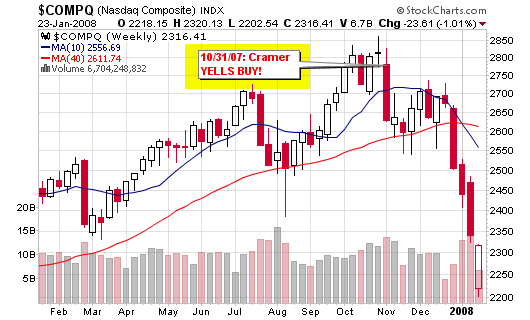
Jim Cramer was yelling about buying overvalued stocks on October 31, 2007 while I was continuously writing about selling, distribution days and taking profits. He also predicted that the banking stocks would be the top performers in 2007 – go figure (at least he paid his $50k bet for losing that prediction). YES, I did upload daily screens and stocks with the strongest relative strength ratings so I am not the superhero of calling this first bear market push but I feel very good about what I wrote (especially since the number of readers continues to increase – that says it all).

012308_cramer_buy.png

Looking back, I offered at least a dozen high quality, highly detailed articles about some type of selling, profit taking or market distribution days. Shame on anyone (including me) that ignored the signals as they slapped us in the face, week after week!

Take a look at some of the highlighted articles I wrote as the market was topping. I think this list contains some of the best work I have ever done on this blog or my former equity research website. Finding growth stocks and presenting them during an up-trend is the easy part. Selling and profit taking is the hard part; let me correct myself – selling is the hardest aspect to grasp when trading (in my opinion of course).

A Review of Articles Talking about Selling, Profit Taking and Market Distribution:

  • 10/03/07: Is Shanghai a Nasdaq Déjà vu

    Well, the current two year rise of the Shanghai Stock Exchange Composite Index looks remarkably similar to the rise of the NASDAQ of the late 1990’s and the charts below explain better than I can!

  • 10/04/07: A Technique for Profit Taking

    What do you do in a market like today when you have profits in multiple positions but you don’t want to give it all back? You want to continue to ride the winners but at the same time, you want to maintain the unrealized gains in your account. HOW?

  • 10/12/07: Distribution Day

    This was the largest showing of volume in two months and is not healthy because it was pure distribution. It was only the second distribution day over the past month so we can’t call this a bear run but please be on the lookout for a possible correction of 5%-10%. Technology stocks led the decline as BIDU gave back 10% of its amazing run.

  • 10/15/07: How to Make Money Selling Short
  • 10/17/07: Inverse ETFs

    Have you ever wanted to short the market because you knew it was going down but your were too overwhelmed, nervous or even scared because you were unsure of how to do it. Well, Inverse ETFs may be your thing.

    These inverse ETF’s closed Wednesday with gains of 13.42%, 15.43%, 22.31% and 18.76% since I wrote about them.

  • 10/18/07:The Real PTR Climax Run?

    I was early in September by trying to locate a climax run in PTR in this post:
    Petrochina (PTR) Climax Top? However, the HUGE volume on the latest push to new highs clearly indicates something is going on.

  • 10/20/07: Second Major Distribution Day

    Technically speaking, we now have 4 distribution days for the NASDAQ and 3 for the DOW over the past month. It’s now time to start focusing big-time on the market leaders to see where they are going to take this market. If they start to roll over, you better be quick to take profits and even quicker to take losses.

  • 11/01/07: CROX getting Swallowed

    I wrote a post titled Will CROX get Eaten? on September 20, 2007 and strongly noted the declining institutional support (see numbers below). Someone was jumping out of the stock and we now know why!

  • 11/08/07: Market Corrections, Bears and the Big Picture

    Keep in mind that nearly 75% of all stocks follow the general market trend. Your cash doesn’t need to be committed to the market at all times. This philosophy is suited to making the most money in bull markets or markets trending higher.

  • 12/11/07: When to Sell

    Why do so few books exist on the subject of “How to Sell”? Selling techniques are far more complicated than buying techniques and subject to considerably more emotional pressure, than those of buying.

012308_cramer_top.png

I promise that I will get back to analysis and uploading charts by next week the latest. That’s what I love doing most anyway and it seems to be the biggest draw in traffic.

Share