To short means that you borrow stock from your broker to sell to a third party. The idea is to buy back the stock at a lower price, returning the shares to your broker while leaving the remaining cash in your account as a profit. A short seller does not own the stock before they sell it as they borrow it from another investor who already owns it. At a later date, the short seller buys back the stock they shorted and returns the stock to close out the loan. If the stock has fallen in price since they sold short, they can buy the stock back for less than they received for selling it. The difference is your profit. Please note that short selling is a transaction made on margin.
Characteristics of Trend-trading Shorts
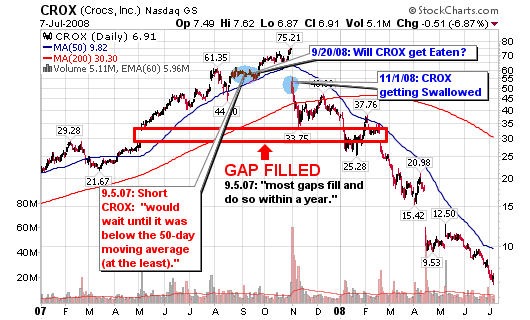
Most ideal longer term trend shorts take four to twelve months after the peak price to setup on the weekly chart with the majority of these shorts triggering between six to nine months.
- Look for stocks that had prior up-trends and support levels that can now act as downward resistance or entry areas.
- Once a stock tops and starts to consolidate, you want it to slice through the 50-d moving average and then the 200-d moving average.
- A crossover between the 50-d m.a. and the 200-d m.a. is ideal and is graphically presented on the KNOT chart
- The odds of success increase with each failed attempt for the stock price to recover these major long term moving averages.
- Head and shoulder tops can also serve as ideal setups for potential shorts if they take at least five months to develop.
- A decreasing relative strength line and a negative pattern on the point and figure chart can also confirm that the stock is rolling over and setting up an ideal short.
- Finally, volume should be increasing and the stock should be under distribution as it violates the major moving averages and starts to break former support levels.
CROX Example:

To initiate a short sale, you must place the order with your broker or online brokerage by determining the size and price at which the trade will occur. Your broker or brokerage company will check to see if shares are available in the specific stock selected or if they can borrow the shares. Once they are available or can be borrowed, they will be sold in the open market on the first plus tick or continuation of an up-tick also known as zero-plus tick (the stock must move up for the transaction to complete). To close the short position, the broker will purchase the shares using the original proceeds and return the shares to the third party.
As a short seller, you believe that the price of a particular stock will fall in value over time. For example: by establishing a short position for 100 shares in XYZ at $50, the broker will place $5,000 into your margin account. If the stock falls over the next few weeks and you decide to cover the short at $40, you will initiate a buy for 100 shares in XYZ using the money placed in your account when you sold short. The cost to buy back the shares in this example will be $4,000 or $1,000 less than the original short sale amount. This difference in price will result in $1000 cash that will now become your profit.
On the flip side, if the stock was to jump to $60, you would most likely cover your short or have your stop loss triggered, buying back the shares at this price. The cost would be $6000 or $1000 more than the original short sale, resulting in a 20% loss. The broker would take the additional $1000 from your cash account to cover the loss in the short sale. This is how you can lose money when shorting stocks. The higher the stocks rises, the more money you can lose, theoretically resulting with an infinite loss (excluding stop losses and broker margin calls).
Read more »