Top Articles for the New Year

Happy New Year!

Share

Understand the ‘M’ in CANSLIM

Happy Halloween!

What does the ‘M’ in CANSLIM stand for?
Allow this post to serve as a reminder of our studies of the market in the past. I speak about the ‘M’ in CANSLIM many times throughout the year because of it’s great importance.

According to William O’Neil (www.investors.com) , it represents the overall health and direction of the major market indexes (Dow, NASDAQ and S&P 500). It is very important to understand and recognize what type of market you are in before you ever place a position (specifically trend traders). How can we realistically make money and set goals based on a blind strategy without knowing if the current market is in bear mode, bull mode, up-trending, down-trending or if it is trading sideways. The market trades sideways about 80% of the time so this leaves us with sustainable trends roughly 20% of the time. Three-quarters of all stocks will follow the general trend of the major indexes so don’t try to swim against the current.

By ignoring the ‘M’ in CANSLIM, your portfolio may get hit with losses by trading on the wrong side of the trend. Simply picture a river and understand that it is much more difficult to swim up-stream than it is to swim with the current downstream. The stock you buy may have a nice basing chart pattern and excellent fundamentals but it may come under pressure and move in the opposite direction anticipated due to the general market weakness and/or sector weakness. The same can be said in a bull market; a stock that is a sub-par performer may act strongly and give the investor solid gains due to sector strength and/or overall market strength but the gains are primarily due to sister force (in this case, a bit of luck helped your position).

Study the market and you will see that stocks move in groups and many of the stocks in a strong industry will move in tandem. The same holds true for weak markets; if you own a stock in an industry that is starting to churn or breakdown, it may be wise to pull in a portion of you position to lock in gains before the bottom drops. More times than not, the leading stock in an industry group must conform and move in the direction of the others.

As many of you know, I also use the daily new high and new low ratio (NH-NL) to compliment the overall strength that the market is presenting. The price and volume alone can fake out many investors and lead them down the path of faulty investing. In order for the market to be a formidable bull, the NH-NL ratio must compliment the general outlook and present us with at least 500 new highs per day on a consistent basis. When both the NH-NL ratio and the ‘M’ in CANSLIM are strong, we can justify placing larger positions (maximum 1-2% portfolio risk) and label the market as a bull.

William O’Neil, the founder of Investor’s Business Daily, states that many of the most profitable stocks over the past 50 years made their advances when the overall market was strong, not weak. The NH-NL ratio is always comprised of the strongest stocks in the current market and we know that these individual leaders are responsible for the bulls and the bears.

How can an investor monitor the market action to tell if it is weak or strong?

[Read more...]

Share

Pivot Reversal – Day 1

I think…, I predict…, I expect…, They said…, etc…

Everyone is an expert when it comes to the market, or at least a certified psychic. Everyone seems to think they know what’s supposed to happen, especially if you read the articles around the web and the newspapers on the stand.

You know what I think: Talking heads are useless!

Why don’t we just sit back and allow the market to tell us where it wants to go. I can’t say that expected the market to rally more than 10% or almost 900 points the exact morning I post the parameters to a pivot reversal (the article was written Monday night while watching the Titans smack around the Colts).

In any event, the market clearly marked day one of the attempted rally. No argument here.

Is it too early? Should we wait on the sidelines? Should we wait for the election? Are you scared to trade? Are you scared to lose? Are you embarrassed to be wrong?

Rule #1: Wait for a follow-through on overwhelming volume, 4-10 days from today’s 10% surge. The signal will be “buy” if we get a follow-through, so add a few shares at that time. Maybe it will reverse but we can’t think to hard about rules etched in stone, so we can only act based on the historical odds presented by this scenario. Trade small; enter a position that is 1/3 or 1/2 of your regular position size or trade fewer units but don’t sit on the sideline because you “think” this is a false move.

[Read more...]

Share

How to Spot a Market Reversal

Before we get into screening individual stocks, let’s refresh our memories and understand what we are looking for in the major market indices: We are looking for a market reversal or as Jesse Livermore called it, the pivotal point.

“Whenever I have had the patience to wait for the market to arrive at what I call a “Pivotal Point” before I started to trade; I have always made money in my operations” – Jesse Livermore, 1940

Market direction or the ‘M’ in CANSLIM as I have highlighted it in the past is the most critical characteristic to consider when investing. Seventy five percent of all stocks follow the general market averages with these numbers becoming more skewed in times of extreme pessimism (like now – 90% of all stocks are following the carnage).

Bear markets are necessary to help deflate the overvalued price/ earnings ratios and overpriced shares in times of extreme exuberance. Bear markets create widespread negativity, overwhelming pessimism, fear, uncertainty and a total lack of confidence among investors. Cash exits the stock market as people panic like sheep and prices start to adjust back to reasonable levels, paving the way to new opportunities around the corner.

We are clearly looking for a new uptrend that sustains some life with a rally on above average volume. Bear markets will provide several head fakes as they typically fall in multiple waves of lower highs and lower lows. It usually takes the majority of stocks listed on the exchanges to sell off enough that a true base can form that will propel the next up-trend or bull market.

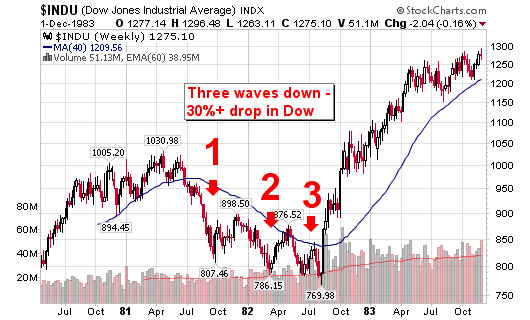
Study the charts below for the down-waves prior to the 1982 and 2002 bull markets. I selected these two years because they represent the strongest up-trends (bull markets) following a bear market over the past 30 years.

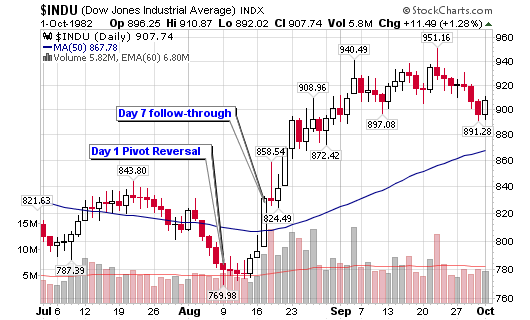
The first rally will feature one or more of the major market indices gaining at least 3% or more on higher volume than the previous day. It is then critical for at least one of these indices to follow-through with similar action four to ten days later (preferably four to seven days later – rules from original O’Neil books).

We won’t be able to tell if the market is building a rally after the first 3% up-swing so give it time and look for at least one, if not multiple follow-throughs from the four day on. The more, the better. Markets will give head-fakes about 1/5th of the time after a true follow-through so we will pay careful attention to the number of waves down during the current bear market. We have had three waves down but only one major wave down on the DOW (it could go lower – easily, before moving higher).

See charts below for the pivot point reversals and follow-throughs for the 1982 and 2002 bull markets.

We must understand that head-fakes and multiple pullbacks are clearly in the historical descriptions of former bear markets. I don’t quite know if the current markets have had sufficient pullbacks before launching a new up-trend (see the charts of the DOW and NASDAQ from yesterday’s post).

[Read more...]

Share

Coach Yourself as a Trader

I was recently asked a question by one of the most respected trader development psychologists/ mentors that I know of in the business. Brett Steenbarger, working on a new project, asked if I could elaborate on what strategies and/ or courses of action I take to mentor/ coach myself as a trader. Brett’s excellent blog can be found at Traderfeed. He specifically asked:

What are the three things (i.e. courses of action, strategies, resources) that you’ve found most helpful in mentoring/coaching yourself as a trader?

And here is how I answered:

  • 1. Understand me. The most powerful tool I have found in life and in this specific case, the market, is what I, as a person, am capable of doing as a trader. I finally understand that personal characteristics that are engrained in my DNA will only allow me to trade successfully under specific circumstances. For example, I am much more consistent and profitable as a medium term and longer term trend trader than as a day trader (even more so on the long side). I don’t need to be everything, all the time as long as I continue to focus on the areas that bring me the greatest success. Understanding “me” has been my holy grail of understanding how to trade the market with some type of consistency and profitability.
  • 2. Learning to cut losses. It’s almost cliché but not many people can do it (in any aspect of life). I have learned to cut losses in my trading, my career, my hobby of competitive poker and everything else in life where the rule applies. Without this rule, there wouldn’t be a third rule.
  • 3. Study and work hard. Sounds so simple but we live in a very lazy society. It is extremely important to my success for me to continuously study the markets on a fundamental and technical level and learn from my successes and mistakes. If you think about it, we would all start at square one on every trade if we didn’t learn from past situations where we succeeded or failed. Applying the knowledge gained from past experiences allows me to properly analyze similar situations in the future with slightly greater odds of success (or at least I would like to think). Never stop learning is a phrase that I will never stop saying as it proves to be truer the older I get.

P.S. – Sorry for the lack of posts over the past few weeks as I have been in and out of town without much focus on the market. It’s better for me to be mostly in cash at this point in time due to the lack of opportunities crossing my screens. Regular posting will resume as soon as my schedule allows me to focus 110% on the market. I will look to post occasionally as long as I have something of value to add.

Share