My StockTickr Interview

Please see the post titled My Interview at StockTickr that leads to the full text link on StockTickr

Here is an example of the first few Questions and answers:

StockTickr: Tell us a little about yourself, Chris.

Chris: My name is Chris Perruna and I am 29 years old. I currently reside in New Jersey with my wife but was born and raised in NY (still my favorite place). I graduated college with a degree in Architectural Engineering and went to work for a historic preservation firm in Manhattan. I started as an intern with the firm while still in college and worked on several high end projects around the corner from Wall Street. It wasn’t until I was about to graduate that I knew I wanted to work on Wall Street and trade the markets professionally (rather than personally). I even signed up and took the trips to the exchanges each year through my university’s business school. I currently consult for a fortune 500 big builder as an architect (listed on the NYSE) and trend trade for capital appreciation. I am a trend trader looking for gains of 25% or more and losses no larger than 10% (preferably smaller). Understand that this 10% loss is calculated into a position sizing spreadsheet that only risks a maximum of 1% of total capital. My foundation is rooted in CANSLIM philosophies but I developed my system with detailed position sizing calculations and money management rules from Dr. Van Tharp.

StockTickr: What do you like to do outside of trading?

Chris: My hobbies include poker on a competitive level, a men’s flag football league in the fall and a softball league in the spring. It drives my wife nuts but I like to compete in most things I do so sports, poker and the market feed that craving. I also enjoy traveling, attending professional baseball and football games and dining at great restaurants. Del Frisco’s (NYC) gets the nod here!

StockTickr: How did you get started trading stocks?

Chris: I open my first brokerage account as a sophomore in college and have not stopped trading since. I first gained an interest in trading from my father who owned restaurants and traded heavily in the 1970’s and 1980’s. I still trend trade heavily based on his 200-day moving average plays. I started tracking stocks when I was a teenager but didn’t become “obsessed” until college. I started college when the 1990’s market was starting to really boom and I benefited greatly over the first couple of years – it was all luck, pure luck.

StockTickr: Most traders have a horror story about losing their shirt when they first started trading. What’s yours?

Click Here to view the entire Interview
030607_stockticker_interview.PNG

A Study in Human Psychology

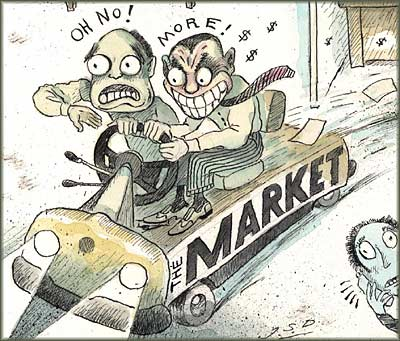
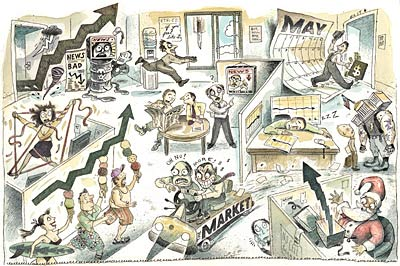
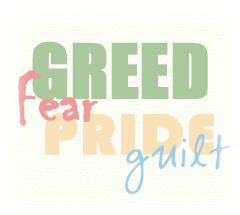
The stock market is a study in human psychology with human emotion driving all market action. The market acts as a pendulum, which swings with emotion and psychology. These emotions can include but are not limited to greed, fear, hope, excitement, sadness, etc. Since the market is fueled by humans, these emotions never change. As Jesse Livermore once pointed out; the names change, the players change and the prices change but the patterns always repeat because they are patterns based on human emotion.

030707_fear_greed.PNG

Emotions can and will determine your success or failure while trading the stock market. When you learn to control emotions, you are at least half way towards winning the battle. Without control of your emotions, no matter how successful a system or set of rules, consistent profits will be difficult to obtain.

The stock market is not the only place in life where human emotions are constantly flowing and can be followed or charted. While driving in the car over the past few weeks, I have heard human emotions at their highest and lowest levels while listening to sports talk radio. I am in the NY metropolitan area so the main subjects are the Yankees, Mets, Giants and Knicks. It amazes me to hear callers on a day after their team loses versus callers on a day after their team wins (many times the same exact callers).

030707_up_down.PNG

I want to present two examples of human emotions at their best. One from the stock market and one from the sports world; the same emotions surface but they take place in different entities.

Stock Market Example:
How does the average investor react after buying a stock that:

a. Goes up in price:
b. Goes down in price:

When scenario ‘A’ takes place, most average investors will start to hope that it keeps going up but as the stock continues its advance, fear starts to overcome their emotions. They now fear that the stock may come back down and they will lose the current profit. On up days, the investor feels like a genius but is scared to allow the profit to deteriorate so he looks for every reason to sell and hate the stock. On down days, the investor has all the hope in the world that the stock will recover and he loves the stock even though it is telling him that his judgment may be wrong. As a result of these emotions, they will sell the stock with a small profit with no other reason justifying the sell. The investors kicks himself when he sees that the stock he sold for a small profit is now trading 50% higher without any major selling violations along the way.

030707_fear_guilt.gif

In scenario ‘B’, the investor starts to hope that the price will rebound and the negative action is temporary. The proper research was done and the investor believes that he has a great stock and it has to be successful (the market is wrong he thinks to himself). The investor starts making excuses as to why the stock is now in negative territory. He continues to hope for a recovery and will actually purchase additional shares at the lower price by averaging down. By averaging down, he convinces himself that the entry price is now more favorable with a potential for a larger profit. The stock continues to slide and he keeps hoping for a rebound and may buy more shares by putting good money after bad.

As the stock slides, he promises himself that he will sell on the first rebound to get out with minimal damage. Finally, the stock is up a few percent but volume is higher so he talks himself into holding onto the stock because this is the start of a rebound. Emotions play with his mind and he completely ignores his rules and system. As the rebound dries up, the downtrend continues and he is now just looking to get out on the next rebound. The rollercoaster will continue until he can’t take it anymore and probably sells near the bottom. He finally sells for a large loss and walks away with his tail between his legs.

Sports Talk Radio Example:
How does the average sports fan react and feel after a win or a loss by their team:

030307_1050_espn_logo.png

a. Their team Wins:
b. Their team Loses:

In scenario ‘A’, fans will call up the radio station and explain why their team is the best in their division and how they are going to win it all. Some fans suggest that the coach should be given a contract extension and the management is the best in all of sports. Other fans are already talking about a dynasty and a championship next year before even reaching and winning the championship game this year. Players should get contract extensions and everyone is an MVP candidate. Nothing can go wrong because their team just won (one game – that’s all).

In scenario ‘B’, fans will completely flip flop from what they were saying last week, last month or even last night. The change of emotion is absolutely amazing when listing to sports talk radio on a daily basis. Yesterday they were crowing the team champions and today they explain why the team is a bunch of bums that won’t make the playoffs. The coach should be fired, the general manager is garbage and everyone should be traded.

030307_wfan_logo.png

By listening to the radio, I can hear human emotion whip around the same way it does on a daily chart when news hits the wire. Looking at my charts last night; I can see human emotions and reaction over the past week. Up and down with wild swings and great volatility. The newspapers are spilling over with articles from talking heads about what is happening. The evening and local news stations are now featuring so-called experts on the market after the 400 point slide. They have every Tom, Dick and Harry claiming to be an expert on knowing why the market dropped, how the glitch happened and where the market is headed. I wonder what these fools will say if the market gains 450 points today; I bet they will completely flip-flop like the sports fan.

Human emotion is amazing and I would love to study psychology on a higher level because it fascinates me. Watching the market, playing sports and listening to sports talk radio gives me a front row seat as to how most people react to nonsense. I never realized this until I started to trade but people are neurotic and change their thoughts as quickly as the second hand changes on a clock. I see these reactions at the poker as well but the clearest change in human emotion must be on the radio. Try it out and listen to how fans can switch from one extreme to another in the matter of one day and one win or loss.

As Jesse Livermore said: “There is nothing more important than your emotional balance”

But even he couldn’t follow his own advice in the end. Maybe because he was only human!

Market cartoons courtesy of www.jsdykes.com

My Interview at StockTickr

I am excited to announce that I was recently interviewed by Dave over at StockTickr. He runs a great site with a free portfolio tracker with options to upgrade for the serious investor.

030607_stockticker_interview.PNG

So what is StockTickr?
StockTickr is a free portfolio tracker with an important twist: all watchlists are shared among all users! There are hundreds of users sharing their watchlists right now via StockTickr.

StockTickr is a great way to generate trading ideas by browsing the stocks on the site. Because all watchlists are shared, you can view reports on the most popular stocks added recently or see which stocks have been the most profitable for StockTickr users.

What is StockTickr Pro and the StockTickr Trading Journal?
StockTickr Pro gives you access to a trading journal which calculates the expectancy of your trading system, automatically captures charts for your daily chart review (it plots your entry, stop, and exit points for you), and helps you figure out what is working and not working in your own trading.

My interview can be found through this link: Chris Perruna Interview

Here is an example of a few of the questions asked:

StockTickr: Tell us a little about yourself, Chris.

StockTickr: What do you like to do outside of trading?

StockTickr: How did you get started trading stocks?

StockTickr: Most traders have a horror story about losing their shirt when they first started trading. What’s yours?

StockTickr: What single lesson did you learn along the way that has helped you the most in your trading?

StockTickr: Describe your style of trading. How long do you typically hold stocks?

StockTickr: What’s your exit strategy for winning and losing trades?

And much more!

Head on over to Dave’s excellent site to view this interview and many others from great bloggers such as TraderMike, Howard Lindzon, Brett Steenbarger and even Van K. Tharp. I highly recommend his book, Trade your way to Financial Freedom, as I am currently reading the newly released and updated version. I can’t tell you how many times I have gone over my original copy.


Enjoy!

History & Experience Tell All

I am going to repeat the quote that I wrote last Monday in the post titled General Market Update; from a fund manger from Oppenheimer Capital named Eugene D. Brody:
“Sell stocks whenever the market is 30% higher over a year ago”

030507_nasdaq.png

Here’s another quote from Victor Sperandeo (I highly recommend his book):

“…the median extent for an intermediate swing in the DOW during a bull market is 20 percent. This doesn’t mean that when the market is up 20 percent, it’s going to top; sometimes it will top earlier, sometimes later. However, what it does mean is that when the market is up more than 20 percent, the odds for further appreciation begin to decline significantly.”

Thus, if the market has been up more than 20 percent and you begin to see other evidence of a possible top, it’s important to pay close attention to that information.”

030507_dow.png

I tend to agree with what Vic Sperandeo says especially since I think his book is one of the best around. By reading his entire book, you will understand where he is coming from and how he concluded that 20% represents a key number where odds decrease significantly. History always repeats!

030507_snp_50d.png

Fitness Friday – HIIT Dumbbell Rush

I love talking about the stock market but I switched my domain name to this web address so I could talk or debate about other subjects with my community of readers. Friday is a great day to talk fitness and I am true believer that a strong body helps create a strong mind. This is why I attempt to stay in shape with multiple workouts throughout the year. To start this new category, I am going to explain my current 10-week workout that was designed to get me into shape for my trip to Hawaii in April.

030207_dumbbells.PNG

Input from all you workout enthusiasts is encouraged as I am always looking for new techniques and ways to push my body.

What has worked for you?

As you may know, the human body adapts to vigorous workouts so they become less effective over time without changing focus and technique. Unlike my market strategy, I am always changing programs and systems when staying in shape.

I recommend the workout below to anyone looking to shed some pounds (excess body fat) and gain lean muscle for a great looking body. Or at least a body that looks great compared to 95% of the people at the beach or pool. All it takes is that slight extra effort and you will be ahead of the curve. Humans are lazy by nature so you can stand out and feel great by doing this regimen 3-5 times per week for 20-45 minutes. Summer is around the corner so this 10-week program works perfectly!

Tools needed to succeed:
A dumbbell set from 10lbs to 70lbs (up to 50 for beginners)
A utility bench (flat, angled and 90 degree adjustments)
Pair of weight gloves to protect that delicate skin (just kidding)
Running Shoes (optional but important if you will do the HIIT sprints)

030207_dumbbell_plt.PNG

Regime Name: HIIT Dumbbell Rush

*HIIT is the acronym for High Intense Interval Training
*HIT will also work for High Intense Training

Objective: burn maximum calories during and after the workout using dumbbells for free weight exercise and HIIT wind sprints for a multi-day metabolism boost.

Skip for a day of rest as listed below or whatever feels most comfortable to you.
For maximum fat loss, sprint 2-3 times per week at HIIT levels for 20 minutes.

HIIT Dumbbell Rush

Day 1 – Chest and Tri’s

Chest

  • flat bench dumbbell press, 4 sets
  • incline bench dumbbell press, 3 sets
  • dumbbell flys (flat), 3 sets

Triceps

  • single arm overhead tricep extensions, 3 sets
  • dumbbell skull crushers (flat), 3 sets
  • tricep kickbacks, 3 sets
  • Seated Dips, 3 sets (use bench and another chair)

Day 2 – HIIT Wind Sprints (optional)

  • Warm-up with light job and stretching
  • 10 – 100-yard wind sprints at maximum capacity (beginners should start with 3-6 sprints and build to maximum effort and consult a doctor if you have not been active in years)

030207_track.jpg

Day 3 – Back and Bi’s

Back

  • single arm bent over rows, 3 sets
  • lying row, 3 sets
  • dumbbell lateral raise, 3 sets

Biceps

  • standing dumbbell curls, 3 sets
  • seated incline dumbbell curls, 3 sets
  • concentration curls, 3 sets
  • hammer curls, 3 sets

Day 4 – Off Day

  • Relax and rest
  • Make sure you are keeping a small journal of all exercises with progress over the 10 weeks. Write down the foods you eat at each meal and snack for further analysis.

Day 5 – HIIT Wind Sprints (optional)

  • Warm-up with light job and stretching
  • 10 – 100-yard wind sprints at maximum capacity (beginners should start with 3-6 sprints and build to maximum effort and consult a doctor if you have not been active in years)

Day 6 – Shoulders & Legs

Shoulders

  • seated dumbbell press, 4 sets
  • front raises, 3 sets
  • lateral raises, 3 sets
  • shrugs, 3 sets

Legs

  • Squats
  • Lunges, 3 sets
  • calf raises
  • HIIT (when applicable)

Day 7 – Off Day

  • Relax and rest
  • Make sure you are keeping a small journal of all exercises with progress over the 10 weeks. Write down the foods you eat at each meal and snack for further analysis.

There you have it! Skip the sprints and you only need to workout for three days for approximately 45 minutes at a high intense level. I started at a weight of 184 last month with a goal of 170-172 (currently 178-179 with five weeks to go). Although actual scale weight is not important, I still use it as a secondary measuring stick. My first measuring stick is my clothing and waist size. People with a lean body of muscle can definitely weigh more than people with a flabby loose body. One pound of lean muscle is a lot more compact that one pound of loose body fat.

For example: A fit athlete that stands 6 feet tall weighing 205 lbs will look leaner than an average person with flab that also stands 6 feet tall and weighs 190lbs. The athlete won’t have a gut or a high percentage of body fat yet they can weigh a lot more than your average chubby person.

One last set of notes:

  • Abdominal all days while resting between sets
  • Jump rope or jump in place while resting between sets
  • Pull-ups, dips and pushups – outside when applicable during HIIT days

030207_bench.PNG

Please add your comments as I will look to build upon this category from time to time using your input and ideas as I workout and change my regimen.