Don’t Forget about Past Trades

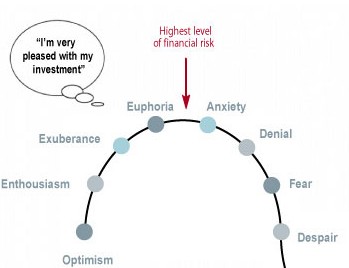
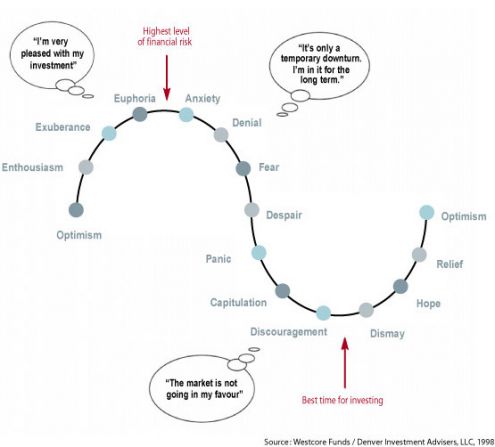
Emotions control our decisions everyday and the greatest leaders and traders learn to harness these emotions and use them to their advantage. As soon as money is involved in a transaction, whether it be the stock market, real estate, art work or antiques; emotions ultimately set the final price. Some investors have greater control over their emotions while other investors are destroyed by their emotional reactions to certain situations and events.
021207_emotions_top.jpg

One common trait many novice and advanced investors share, including me, is placing a position in a stock at the wrong time. Years ago, I would study a stock’s chart, the fundamentals, the general market health and everything else that I felt necessary before placing a position behind my beliefs. When things went wrong and I was forced to sell based on my basic stop loss, I would drop the stock from my watch lists and remove it from my memory. This was one of the biggest mistakes that I was making during my earlier years of investing. The greatest investors study their mistakes and learn why they were wrong and have no problem getting back into a stock they just sold if another signal is given. If you don’t learn from your mistakes, you will continue to repeat them and never move to the next level. It is extremely importance to stay focused and emotionally stable when things don’t work out as expected.

I was typically correct with my overall stock analysis but many times I was too early with my entry point. Months later, I would come across the same stock in my screens but it was now up 25%, 50% or more from my initial buy point and stop loss. I was frustrated for selling my stock too soon and was getting tired of using basic CANSLIM sell rules and missing big winners that I sold for an 8% loss.
021207_emotions_bottom.jpg

I knew money could be made on Wall Street using the law of averages to my advantage by employing strong money management skills but I had to become more consistent in my approach and grasp a better understanding of how money management truly worked. I started to practice what I was taught by selling my losers quickly and allowing my stronger stocks to ride their trends. Over time, I was experiencing more losers than winners but my stake was growing because these losers were smaller in size than the winners. The words written by my book mentors were true; Jesse Livermore, Gerald Loeb and William O’Neil were all accurate with their lessons about cutting losses quickly. However, the light bulb didn’t truly shine until I read Trade your Way to Financial Freedom by Van K. Tharp. After reading the book, I became more confident and successful by learning to develop a risk to reward ratio for each trade and by setting detailed position sizing calculations.

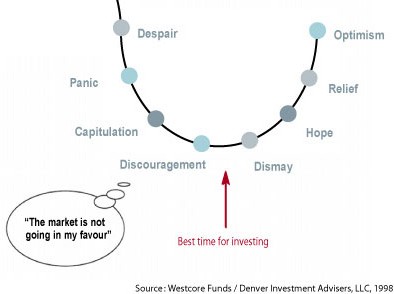
More importantly, I learned to keep strong stocks on my radar even if I bought too soon and was forced to sell for a loss. My timing was wrong and my ego was shot because I was wrong, so I typically decided to stay away from that specific stock because it had already taken my cash and my pride. Emotionally, I was burned by the stock even though this was not entirely true. Investing is a game of trial and error. It is okay to buy a stock at the wrong time and sell, only to buy it again because they timing may be better. If you cut the losses small and allow winners to grow, your expectancy will ALWAYS work out, I promise. You must be honest with yourself to allow the averages to work out. You cannot allow a stock to drop past your sell point and you must try to always hold the strongest stocks without selling them during a premature pullback. This all sounds so easy but it is not! If it was so easy, we would all be extremely rich and the stock market would be everyone’s full time job.
021207_emotions_sm.jpg

It is mentally and emotionally difficult to purchase a stock at a higher price now then it was at an earlier date but it can be the most rewarding strategy. Never look at a chart and toss away a candidate because it has moved up 50% or even doubled in recent months, the real move may just be beginning.

The moral of this article is to make you understand that timing may be your only issue when buying stocks so never throw away a possible superstar because you bought too soon. Keep it on your watch list and be prepared to initiate another position, even if it will cost you an extra point or two. If you buy again and it doesn’t work out; repeat the process as there is always a chance that the stock was not meant to be or your analysis was faulty. In either case, learn what you are doing right and wrong so you can be prepared to use those lessons with the next opportunity.
New High – New Low (NH-NL) Ratio

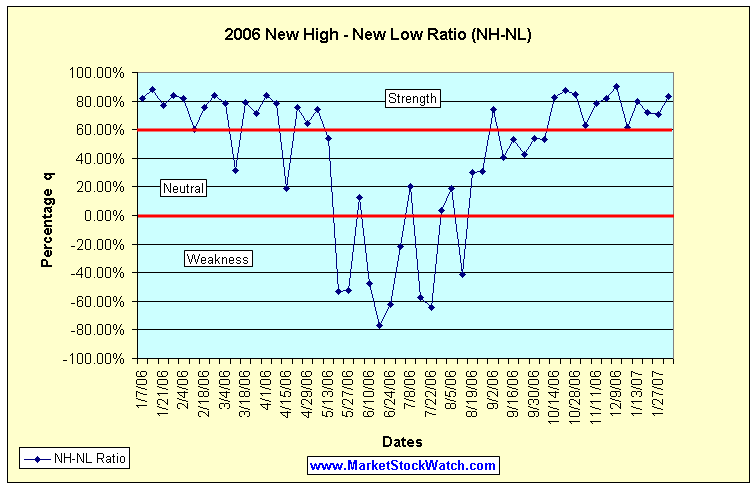
I wanted to take the time to update the latest New High – New Low (NH-NL) ratio chart which I follow from week to week on the MSW Index. Based on my research in 2005 and 2006, I have changed the level of bullish or positive signals to 60% from 80% with neutral now representing all readings between 0% and 60% and bearish or negative signals below 0%.

020907_nh-nl_ratio_sm.PNG

The chart in this post shows a graph that highlights the strength and weakness on the NH-NL ratio during 2006 and 2007. To calculate the percentage correctly, use this formula:

(New Highs – New Lows) / (New Highs + New Lows) * 100 = X%

For a further understanding of how I use the NH-NL ratio, read this post I made back on Tuesday, October 25th, 2005:
New High – New Low Ratio (NH-NL)

The weekly averages for the NH-NL Ratio (2007):
Saturday, January 6, 2007: 279-67, 61.27%
Saturday, January 13, 2007: 344-39, 79.63%
Saturday, January 20, 2007: 281-46, 71.87%
Saturday, January 27, 2007: 316-55, 70.35%
Saturday, February 3, 2007: 502-45, 83.55%

To View the numerical readings from 2006, visit this post:
New High – New Low Ratio

EDU Breakout on Huge Volume!

Stock of the Day – Update
New Oriental Education & Technology Group Inc.

020707_edu_weekly.png

Wednesday’s Closing Price: EDU – $40.80
Monday’s Closing Price: EDU – $36.93

Up 10.4% since writing the case study with a breakout today on volume 254% larger than the average. It traded more than 900k shares which crushed the average of 300k+.

020707_edu_daily.png

As I said yesterday (Institutions are pouring in):

I like when I see $227 million worth of shares purchased and 93 new institutional holders versus only $770 thousand worth of shares sold. This shows me major support and interest by the so called “smart-money”. The company sounds interesting and looks to have an excellent market (a description is below).

Held by Institutions: 13.10%
Money Market: 45 (42 new positions)
Mutual Fund: 51 (50 new positions)
Other: 1 (1 new position)

Shares Bought last Period: 6,313,271
Shares Sold last Period: 22,600
Value of Shares Bought: $227,073,203
Value of Shares Sold: $770,637

Learning about New Oriental Education (EDU)

Stock of the Day
New Oriental Education & Technology Group Inc.

Monday’s Closing Price: EDU – $36.93

Sector: Consumer Discretionary
Industry: Education Services

020607_edu_daily.png

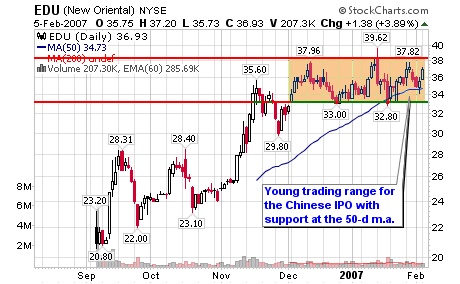
Not a lot of data exists for the young Chinese stock so I wanted to take the time to focus on institutional holdings and the amount of shares that have been accumulated so far (the first reporting period). As you can see below, the majority of new institutional investors loaded up over the past couple of months and I suspect that it all started in November when volume surged and the price accelerated from $26 to $33.

The stock has since consolidated and traded sideway with support near $33 and at the 50-d moving average but is starting to trend higher (slowly). I don’t own shares as I write this report but I am looking to own shares within the next couple of weeks (could be as early as today). I am currently setting up my risk/reward strategy and calculating my stop loss and potential target area. I have limited data to calculate a realistic target but I do have enough to set up my sell stop and total risk.

I like when I see $227 million worth of shares purchased and 93 new institutional holders versus only $770 thousand worth of shares sold. This shows me major support and interest by the so called “smart-money”. The company sounds interesting and looks to have an excellent market (a description is below).

Held by Institutions: 13.10%
Money Market: 45 (42 new positions)
Mutual Fund: 51 (50 new positions)
Other: 1 (1 new position)

Top Holder: Massachusetts Financial Services Co.
1.3 mil Shares for < 0.01% of Portfolio Total Equity Value of Portfolio: $86.0 billion Shares Bought last Period: 6,313,271
Shares Sold last Period: 22,600
Value of Shares Bought: $227,073,203
Value of Shares Sold: $770,637

Key Fundamental Numbers (Yahoo Finance):
Market Cap (intraday): 1.36B
Enterprise Value (6-Feb-07): 1.17B
Trailing P/E (ttm, intraday): 58.62
Forward P/E (fye 31-May-08): 40.59
PEG Ratio (5 yr expected): 2.01
Price/Sales (ttm): 11.61
Price/Book (mrq): 6.38
Enterprise Value/Revenue (ttm): 9.96
Enterprise Value/EBITDA (ttm): 34.579
Profit Margin (ttm): 16.31%
Operating Margin (ttm): 17.42%
Total Cash (mrq): 149.93M
Total Cash Per Share (mrq): 4.057
Operating Cash Flow (ttm): 37.41M

Next Year Estimate: 0.75
Next Quarter: 0.06
Last Quarter: 0.03

Earnings:
Yearly (2006): 0.12

Revenue (millions):
Yearly (2006): 96.06

Net Income:
2006: 39.8

Cash Flow:
2006: 81.6

020607_edu_weekly_sm.png

About New Oriental
New Oriental is the largest provider of private educational services in China based on the number of program offerings, total student enrollments and geographic presence. New Oriental offers a wide range of educational programs, services and products consisting primarily of English and other foreign language training, test preparation courses for major admissions and assessment tests in the United States, the PRC and Commonwealth countries, primary and secondary school education, development and distribution of educational content, software and other technology, and online education. New Oriental’s ADSs, each of which represents four common shares, currently trade on the New York Stock Exchange under the symbol ”EDU.”

Net income for the six months ended November 30, 2006 was RMB173.3 million (US$22.1 million), representing a 135.7% increase year-over-year.

For the six months ended November 30, 2006 New Oriental reported net revenues of RMB598.4 million (US$76.4 million), representing a 31.8% increase year-over-year.

Digging for PetroChina (PTR)

Stock of the Day
PetroChina Co. Ltd.

Monday’s Intra-day Price: PTR – $123.38

I am going to stay on the China bandwagon with PetroChina, the leading company in that country with a broad range of petroleum-related activities, including: the exploration, development and production of crude oil and natural gas; refining, transportation, storage and marketing, including import and export, of crude oil and petroleum products; production and sale of chemical products; and the transmission, marketing and sale of natural gas.

020507_ptr_weekly_sm.png

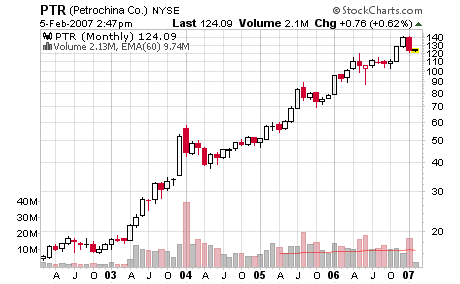
Warren Buffet has more than a $1 billion stake in this company through Berkshire Hathaway and according to reports, holds more than 9 percent of the publicly traded shares. The reports I am referring to came out in 2003 (see monthly chart below), when PTR was trading much lower (showing why he is the greatest investor ever). It never hurts to have Buffet on your side!

PTR has been screened on the MSW daily screens several times over the past 12 months but it was never added to the MSW Index or placed in the portfolio. I can’t take credit for any of the gains over the past couple of years but I would like to be part of any gains that may take place in the future.

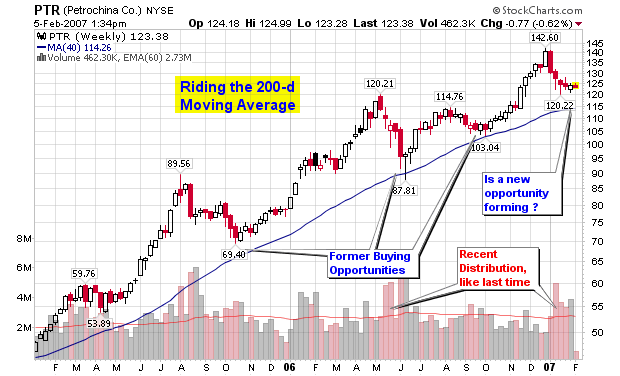
The stock is currently forming a consolidation pattern above the 200-d moving average, similar to the support it received three times over the past two years (see the chart). If the stock can maintain support, the current trading range will become the next buying opportunity. The recent declines were logged in as distribution but the stock was also catching support during those down-weeks.

Sector: Oils/Energy
Industry: Integrated Oil and Gas
52 Wk Range $89.85 – $142.60

Stat: Value of $10,000 invested five years ago: $86,982 today

Held by Institutions: 11%
Money Market: 202
Mutual Fund: 71
Other: 13
2.2 million more shares were bought then sold last reporting period.
This equaled a $300 million difference in money transfer to the positive side.

Top Holder: FMR Corporation (Fidelity Management & Research Corp.)
4.5 mil Shares for < 0.01% of Portfolio ($566 million value) Total Equity Value of Portfolio: $618.0 billion (more than half of $1 trillion) Key Fundamental Numbers:
Market Cap.: $21.8B
Outstanding Shares: 175.82M
Short Ratio: 2.20
Net Income $M: 17,036M
ROA (%): 19.7
ROE (%): 29.61
P/E (TTM): 13.4
P/E (Forward): 11.44
Price to Sales Ratio: 0.32
Price to Cash Flow: 1.27
Book Value per Share: 319.12
PEG Ratio: 0.70
Price to Book Ratio: 0.39
Cash Flow per Share: 96.89

3-Year Sales Rate: 30.89%
3-Year Net Income: 44.25%

020507_ptr_mthly.png

Earnings:
Estimated Earnings (2006): 10.93
Yearly (2005): 9.29
Yearly (2004): 7.13
Yearly (2003): 4.83
Yearly (2002): 3.26

Revenue (millions):
Yearly (2005): 552,229
Yearly (2004): 388,633
Yearly (2003): 303,779
Yearly (2002): 244,424

Net Income:
2005: 139,642
2004: 102,927
2003: 69,614

Cash Flow:
2005: 190,947
2004: 149,338
2003: 110,145

Is this just the beginning of the possible 10-bagger run or the top of the Chinese bust that some are talking about? I learn towards the former but will look for corrections to grab shares.