Archives for January 2007

Skip the Cup with Handle (CTRP)

I should have skipped the cup with handle with CTRP in 2005 and bought the 200-day moving average trend buy.

Back on August 23, 2005, I wrote a case study on Ctrip.com Intl. (CTRP) while the stock was trading at a pre-split adjusted $53.57. I knew Chinese stocks were something to watch in the future, especially after the huge speculation runs of SINA and SOHU; so I took a position. Problem is, I took the position on the cup with handle breakout but was later forced to sell based on a sell stop and never caught the entire run (the market was shaky at the time).

013007_ctrp_update_sm.png

CTRP is one of the reasons over the past couple of years why I have minimized buying cup with handle breakouts and search dearly from 200-day moving average trend buys. Later in 2005, when I was forced to sell, the stock held support at the 200-d m.a. and never violated the long term average. This was the ideal trend buy for the young growth type stock. Instead of buying in 2005, I was selling. Now in 2006 and 2007, I do the opposite. I watch others buy the breakout and I enter my positions closer to major support areas such as the 200-d m.a. CTRP was one of the original high fliers from the Chinese market but several new faces are looking to take off, including MR which I highlighted yesterday.

I am reading a pamphlet from Investment U, titled Profit from China by John Wiley & Sons and it’s not bad. I found the quote by Jim Rogers (co-founder of the Quantum Fund) to probably be accurate:

“The nineteenth century belonged to Britain. The twentieth century belonged to the United States. And the twenty-first century will belong to China”

Past Blog Appearances by CTRP:
Ctrip.com (CTRP) Updated – 3/15/06

Tuesday’s MSW Daily Screen – 11/15/06

Here is some of the research from the case study I performed back in August 2005:
8/23/05
CASE STUDY – Cup with Handle Setup
CTRP – Ctrip.com Intl ADS

082305_ctrp_weekly_sm.gif

Leisure Services – Transportation

3-Year EPS Rate: 113%
3-Year Sales Rate: 83%
ROE: 28%
PEG: 1.13

EPS Analysis:
2003: 0.06
2004: 1.02
2005: 1.48 (E) High estimate: 1.62
2006: 1.98 (E) High estimate: 2.39

Revenue: (in millions)
2003: 173.00
2004: 334.00

Net Income: (in millions)
2003: 53.8
2004: 133.00

Number of Institutions (last reporting period):
Total: 38
Money Mangers: 21
Mutual Funds: 16
Banks: 1
Insurance Co.: 0

New Positions: 16
Positions Sold Out: 9

Here are some Updated Numbers from 2007:

013007_ctrp_weekly.png

3-Year Net Income: 150%
3-Year Sales Rate: 75%
ROE: 32%

EPS Analysis:
2005: 0.86
2004: 0.51
2003: 0.03

Revenue: (in millions)
2005: 67.18
2004: 40.32
2003: 20.91

Net Income: (in millions)
2005: 224.0
2004: 133.0
2003: 53.8

Number of Institutions (last reporting period):
Total: 60% Holdings
Money Market: 88
Mutual Funds: 158
Other: 11

As we can see, 67 new money mangers own the stock, 142 new mutual funds own shares and 10 other institutional holders have grabbed shares since my case study in 2005. This explains exactly why the 200-d m.a. held support at each challenge over the past two years.

This is basic common sense!

China’s Mindray Medical Intl. (MR)

Stock of the Day
Mindray Medical International Ltd.
Monday’s Closing Price: MR – $24.95

013007_mr_daily.png

Mindray Medical International Limited engages in the development, manufacture, and marketing of medical devices in China. It offers approximately 40 products through its three segments: Patient Monitoring Devices, Diagnostic Laboratory Instruments, and Ultrasound Imaging Systems. The company’s Patient Monitoring Devices segment primarily offers portable PM-9000 multi-parameter patient monitoring device and approximately 15 patient monitoring devices. The Diagnostic Laboratory Instruments segment offers a range of approximately 10 hematology and biochemistry analyzers that perform analysis on blood, urine, and other bodily fluid samples for clinical diagnosis and treatment. The Ultrasound Imaging Systems segment offers approximately 10 ultrasound imaging systems and it would introduce the color Doppler ultrasound imaging system for use in several clinical areas, such as urology, gynecology, obstetrics, and cardiology. The company sells its products primarily to distributors and directly to hospitals, clinics, government agencies, original design manufacturers, and original equipment manufacturers. It also offers its products in Asia and Europe. Mindray Medical International was incorporated in 2005 and is headquartered in Shenzhen, the People’s Republic of China – Provided by Yahoo Finance

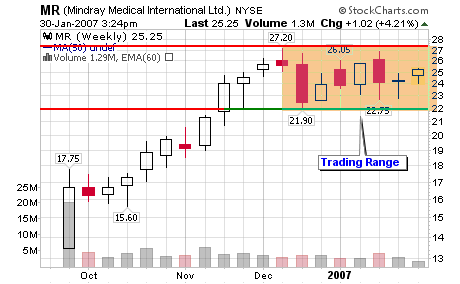
What catches my eye the most about this stock is the number of shares bought and sold during the most recent reporting period! The buy to sell ratio is 39-to-1 which represents institutional accumulation in my opinion and I get warm and fuzzy when these professional buyers support a stock I own (disclosure: I do own shares prior to writing this post). The amount of fundamental data is limited on the young Chinese company but I have listed what I can find using a variety of sources (Yahoo giving me the most data).

Looking at the chart, we can see that the stock is gaining support along the 50-day moving average and is within 15% of a new all-time high (set back in December 2006 at $27.20). The weekly chart shows a flat base that has been forming over the past seven weeks with potential for an up-side breakout. A 200-d m.a. has not formed at this point in time but will be valuable in the future. Overall, I like this young stock and I like the market it comes from.

Here is an insert from a recent SFO magazine article:
Are Communists The World’s Best Capitalists?
by: Jim Trippon

How China has become a driving force in today’s marketplace.

“Find the Stars
I feel the key to success is to buy good companies. I recommend companies that will participate in the best of the Chinese growth story without exposing investors to undue risk. In the long run, I believe the Chinese big cap/value market will bounce above worldwide indices because of the continued growth of both internal and external consumer markets. Many blue-chip Chinese companies pay regular and reliable dividends. Substantial and dependable dividend payments have a soothing way of leveling out the bumps in a volatile market. A solid dividend, sometimes as high as seven percent, helps take the sting out of market volatility.”

013007_mr_weekly.png

Sector: Health Care
Industry: Health Care Equipment
52wk Range: 15.20 – 27.20

Institutional Numbers:
Money Market: 21
Mutual Fund: 75
Other: 4

Shares Bought Last Period: 6.4 million
Shares Sold Last Period: 0.2 million

Value of Shares Bought: $156.4 million
Value of Shares Sold: $4.9 million

Top Holder: Emerging Markets Management LLC
2.1 mil Shares for 0.20% of Portfolio
Total Equity Value of Portfolio: $3.2 billion

Available Fundamental Numbers:
Market Cap.: $1.33bb
P/E (ttm): 59.1
PEG Ratio: 1.42
Profit Margin (ttm): 24.68%
Operating Margin (ttm): 26.31%
Qtrly Revenue Growth (yoy): 21.60%
Qtrly Earnings Growth (yoy): 131.00%
Total Cash: 37.45M
Total Cash Per Share: 0.354
Total Debt: 5.55M
Total Debt/Equity: 0.021
Current Ratio: 6.712
Book Value Per Share: 2.539
Operating Cash Flow : 60.14M

Earnings:
Yearly (2007): 0.59E
Yearly (2006): 0.47E
Yearly (2005): 0.29

Revenue (millions):
Yearly (2007): 269.15E
Yearly (2006): 190.03E
Yearly (2005): 134.9

Growth Estimate (Next 5 years):
35.1%

Support at the 200-day Moving Average

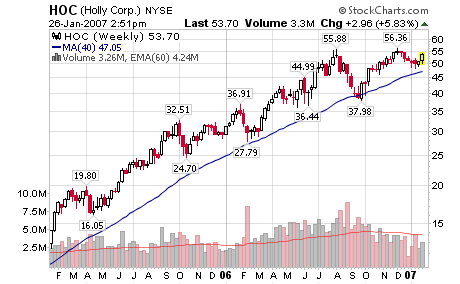
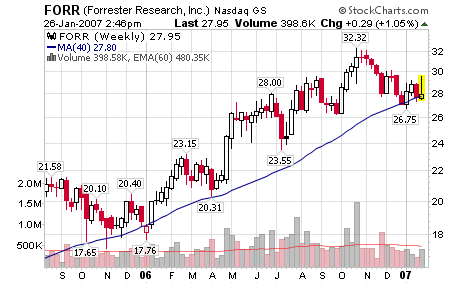
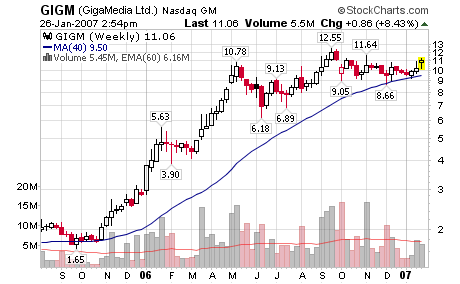
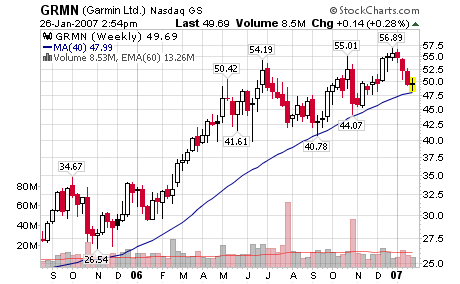
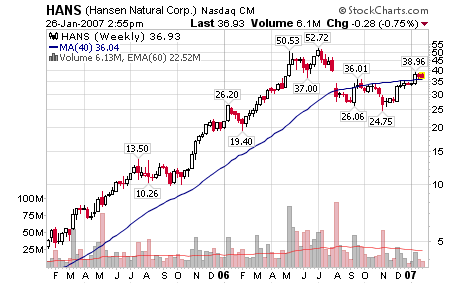
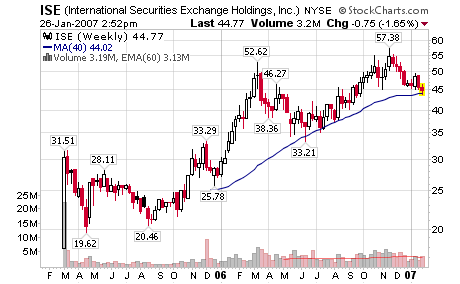
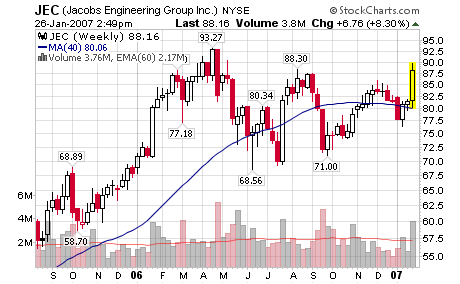
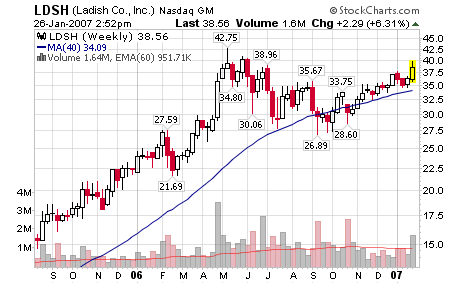
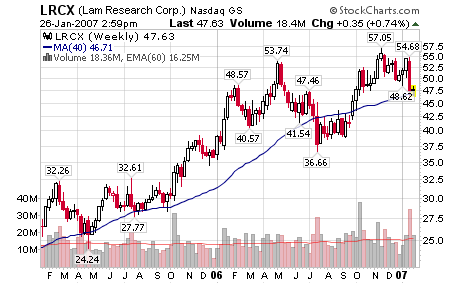
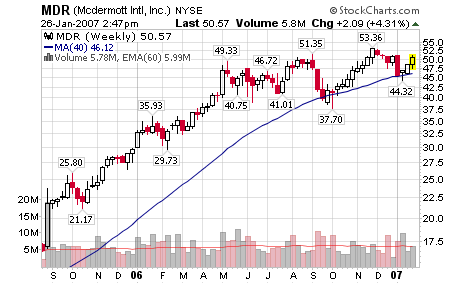
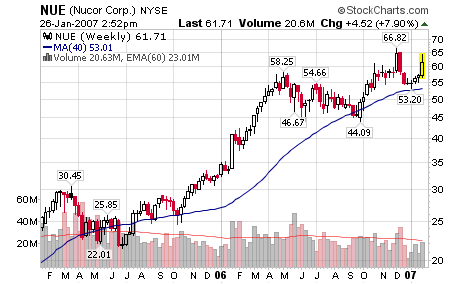
The CANSLIM type stocks listed below are all familiar with their roles of market leadership within the past twelve months but they share another trait:

They are currently trading near support at their respective 200 day moving averages.

012607_hoc_weekly.png

Watching these stocks will also give us a clue to the overall market health as many of them have held support above the long term moving average over the past two years. It will be a major red flag to bulls if several of these stocks break support below the 200-d m.a. on above average volume and then fail to recover the line. Ultimately, the price and volume of the NASDAQ and other major indexes will give us the clue to a market breakdown but these stocks may send the red flags earlier putting us into defense mode. If they don’t breakdown, grab shares when you can along the 200-d m.a. and pyramid your profits higher.

012607_forr_weekly.png

Use the peaks and valleys of the former price swings to develop risk/reward ratios to set stops, targets and position size your trades. Trade these types of stocks like a mechanical system and you will profit over the long term without much effort or concern. These guys have institutional support, so trade the trend until it breaks!

012607_gigm_weekly.png

012607_grmn_weekly.png

012607_hans_weekly.png

012607_ise_weekly.png

012607_jec_weekly.png

012607_ldsh_weekly.png

012607_lrcx_weekly.png

012607_mdr_weekly.png

012607_nue_weekly.png

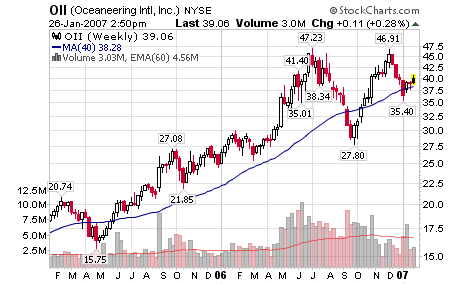
012607_oii_weekly.png

Enjoy the Weekend!

Use PEG Ratio instead of P/E Ratio

PEG Ratio
A PEG ratio cannot be used alone but is a very powerful tool when integrated with the basics (price, volume and technical analysis). You must enjoy crunching numbers and have a calculator or spreadsheet handy to estimate your own PEG ratio. Access to quality statistical information from the web such as past earnings and future earning estimates is essential to calculate this fundamental indicator. A variety of websites produce a PEG ratio but I have not found one site that has a reliable PEG ratio that I can use for my own research, so I calculate it myself, ensuring accuracy with the final number. Besides, I don’t know what earnings numbers these sites are using to determine growth rates and price-to-earnings ratios.

Investopedia.com:
“The PEG ratio compares a stock’s price/earnings (“P/E”) ratio to its expected EPS growth rate. If the PEG ratio is equal to one, it means that the market is pricing the stock to fully reflect the stock’s EPS growth. This is “normal” in theory because, in a rational and efficient market, the P/E is supposed to reflect a stock’s future earnings growth.

If the PEG ratio is greater than one, it indicates that the stock is possibly overvalued or that the market expects future EPS growth to be greater than what is currently in the Street consensus number. Growth stocks typically have a PEG ratio greater than one because investors are willing to pay more for a stock that is expected to grow rapidly (otherwise known as “growth at any price”). It could also be that the earnings forecasts have been lowered while the stock price remains relatively stable for other reasons.

If the PEG ratio is less than one, it is a sign of a possibly undervalued stock or that the market does not expect the company to achieve the earnings growth that is reflected in the estimates. Value stocks usually have a PEG ratio less than one because the stock’s earnings expectations have risen and the market has not yet recognized the growth potential. On the other hand, it could also indicate that earnings expectations have fallen faster than the Street could issue new forecasts.”

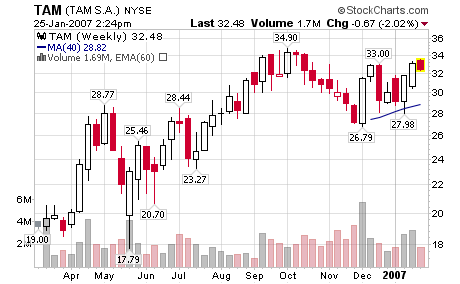
012507_tam_weekly.png

PEG Ratio Example:
TAM S.A. (TAM)
Yahoo Company Profile: TAM S.A., through its subsidiaries, provides scheduled air transportation services in Brazil and internationally. The company engages in the transportation of passengers and cargo within Brazil and on international routes. It offers flights serving various destinations in Brazil, as well as operates scheduled passenger and cargo air transport routes to 46 cities, in addition to a further 27 domestic destinations that the company serves through regional alliances with other airlines.

First, you will need to gather the past earnings numbers; going back a couple years and going forward a couple years. Keep in mind that the numbers going forward are only estimates and that is why this is only a secondary tool to help predict a future price or target.

TAM Earnings:
2005: 1.30
2006: 2.58
2007: 2.86
2008: 3.14

We need to calculate the growth from year to year.
Subtract the earnings of 2006 by 2005 and then divide by 2005.
Repeat the process to determine the growth rate for the following years:

2006: (2.58-1.30)/1.30 x 100 = 98% growth rate

2007: (2.86-2.58)/2.58 x 100 = 11% growth rate

2008: (3.14-2.86)/2.86 x 100 = 10% growth rate

Take the current price (we will use the close from Wednesday, January 24, 2007: $32.62) and divide it by 2006 earnings and then by the 2006 growth rate:
2006: 32.62/ 2.58 / 98 = 0.12 PEG Ratio
2007: 32.62/ 2.86 / 11 = 1.03 PEG Ratio
2008: 32.62/ 3.14 / 10 = 1.04 PEG Ratio

Using the definition from above, Investopedia states that a stock is evenly valued at a PEG ratio of 1 in a rational and efficient market. Please note that the stock market is not very rational or efficient so we only use this number as a secondary indicator and tool, after our fundamental and technical analysis is complete.

Once you determine the PEG ratio of the stock you are looking to buy, take the time to calculate the PEG ratio for the “sister stocks” in the industry group to see if they have higher or lower PEG ratios. Keep in mind, PEG ratios don’t work for companies with negative or non-existent earnings numbers.

Do you want to implement a PEG strategy into your fundamental arsenal; then think about this very basic example?

Let’s say we are looking at two stocks to purchase with these similar characteristics:
They are both trading near $20 per share.
Both stocks have a P/E ratio of 20 (they are trading at 20x’s their earnings)
The first stock grows earnings at a 10% annual rate
The second stock grows earnings at a 20% annual rate

Watch how the price will change in the future assuming that the P/E ratio remains unchanged:

012507_peg_example_sm.PNG

Stock ABC:
Starting Price: $20
Annual Earnings: 1.00
P/E: 20
PEG: 2.0

Stock XYZ:
Starting Price: $20
Annual Earnings: 1.00
P/E: 20
PEG: 1.0

Price in One Year:
Stock ABC: $22
Stock XYZ: $24

Potential Price in Three Years (based on Growth Ratios):
Stock ABC: $26.62
Stock XYZ: $34.56

* Using this very basic example, we can see that stock XYZ with the 1.0 PEG ratio should outperform the stock with the 2.0 PEG ratio due to the earnings growth rate. This is not guaranteed but can help when looking to make a purchase between two similar stocks.

NMX purchases 19% Stake in OPBL

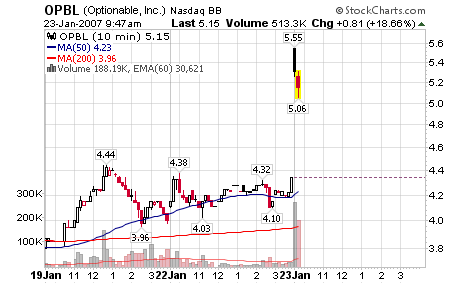
Price and volume were telling the story long before the announcement yesterday. I didn’t see the action in OPBL because I shy away from lower priced stocks but it’s just another classic example showing how technical analysis beats news to the punch! Fundamental analysis could have also clued in an investor as sales and earnings were increasing but the up-trend and huge volume were the ultimate clue.

012307_opbl_minutes.png

I only found out about this story because I am shareholder in NMX and I get news stories sent to my inbox. Take a look at the charts in this blog entry and study how “someone” knew something was going to happen. “Someone” always knows before the news hits the street.

For more about market news, technical analysis and fundamental analysis, see this entry: Do Not use Fundamental Analysis Alone!

BRIARCLIFF MANOR, N.Y., Jan. 22 /PRNewswire-FirstCall/ — Optionable, Inc. (OTC Bulletin Board: OPBL) a leading provider of natural gas and other energy derivatives brokerage services, announced today that it and three of its founding stockholders have executed a binding term sheet for an agreement with NYMEX Holdings, Inc. (NYSE: NMX “NYMEX”) concerning certain cooperative technology initiatives, the acquisition of a 19 percent stake in Optionable by NYMEX from its three founding stockholders and the issuance to NYMEX of a warrant which would permit it to increase its stake.

012307_opbl_daily.png

012307_opbl_weekly_sm.png

About Optionable
Optionable, Inc. is a leading provider of natural gas and other energy derivatives trading and brokerage services, headquartered in Briarcliff Manor, NY. The company provides its services to brokerage firms, financial institutions, energy traders and hedge funds nationwide. In addition to the traditional voice brokerage business, Optionable developed an automated derivatives trading platform. OPEX® is a real-time electronic trade matching and brokerage system designed to improve liquidity and transparency in the energy derivatives market. For more information about Optionable and OPEX please visit www.optionable.com.

About NYMEX Holdings Inc.
NYMEX Holdings, Inc. is the parent company of the New York Mercantile Exchange, Inc., the world’s largest physical commodity exchange. NYMEX offers futures and options trading in energy and metals contracts and clearing services for more than 250 off-exchange energy contracts.

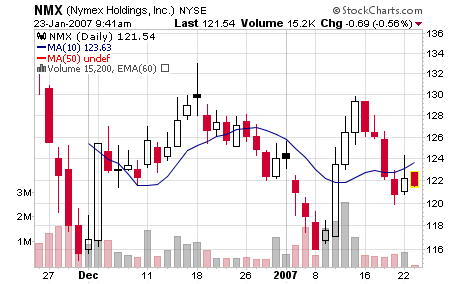
012307_nmx_daily.png

Through a hybrid model of open outcry floor trading and electronic trading on CME Globex® and NYMEX ClearPort®, NYMEX offers crude oil, petroleum products, natural gas, coal, electricity, gold, silver, copper, aluminum, platinum group metals, and soft commodities contracts for trading and clearing virtually 24 hours each day.