Cash Back from Mastercard and Baidu

Why charge when you can buy Mastercard in cash and make a 37% gain in two months. My physical stop has been placed with a GTC trailing stop 10% below the 52-week high. Any direct red flags (hard reversals on large volume) will force me sell prior to waiting for the trailing stop.

I first posted my analysis on Mastercard (MA) back on April 2, 2007:
Is Mastercard Priceless
$107.28 - “Bottom Line: MA is rated a buy in my book and I am grabbing shares today.”

I followed up this analysis with an update on May 3, 2007, Mastercard Pays Off, as the stock closed above $126; this still allowed investors a chance for a 16% gain to date.

053007_ma.png

Mastercard closed today at $147.13

Baidu.com (BIDU) was highlighted twice in one day as I recommended it as an immediate buy after returning from my Hawaii vacation in late April. It has worked well and now has a 31% gain in one month (not bad!).

Baidu.com (BIDU) buy Opportunity
$103.50 - “Short term target for BIDU is $118 area based on point and figure chart and fibonacci retracements.”

BIDU Stock Analysis
$104.34 (chart quote) - “Looking at the charts, I see a golden opportunity for a buy right here near the 200-d moving average with a confirmation above the 50-d moving average (which we got yesterday). “

“I mentioned a short term target of $118 earlier today based on Fibonacci retracement levels and the triple top breakout on the point and figure chart. A full 100% retracement and complete cup formation would take the stock back into the $130’s.”

053007_bidu.png

Baidu.com closed today at $135.69.

Don’t sell for the sake of selling and continue to follow the trend. Place your physical sell stops to guarantee at least a 20-25% gain in both stocks (preferably better). We don’t need to be greedy as the fundamentals still look solid for both companies. Ride the trend and don’t guess the top as some stocks that may seem high are still low to others!
CAN SLIM Breakdown

CAN SLIM is Investor Business Daily’s (IBD) acronym for the seven common characteristics all great performing stocks have before they make their biggest gains. My trading foundation is rooted in CAN SLIM although I use it differently than most beginners now that I have evolved into other styles and methods. I was asked and pleased to guest write about CAN SLIM for Blain over at Stock Trading 101 last week.

His blog is hosted on falkininvesting.com, which is the home of a 501c (3) pending non-profit organization he started with a colleague called the Falkin Investing Organization. They are dedicated to simply connecting traders from around the globe together, while educating as many people as humanly possible on the stock market and investing related topics. Stop by and take a look when you get a chance.

CAN SLIM Letter Breakdown
Let’s start by understanding what each letter represents in the CAN SLIM acronym as described by investors.com:

C= Current earnings per share should be up 25% or more and in many cases accelerating in recent quarters. Quarterly sales should also be up 25% or more or accelerating over prior quarters.

A= Annual earnings should be up 25% or more in each of the last three years. Annual return on equity should be 17% or more.

N= A company should have a new product or service that’s fueling earnings growth. The stock should be emerging from a proper chart pattern and about to make a new high in price.

S= Supply and demand. Shares outstanding can be large or small, but trading volume should be big as the stock price increases.

L= Leader or laggard? Buy the leading stock in a leading industry. A stock’s Relative Price Strength Rating should be 80 or higher.

I= Institutional sponsorship should be increasing. Invest in stocks showing increasing ownership by mutual funds in recent quarters. IBD’s Accumulation/Distribution Rating gauges mutual fund activity in a stock.

M= The market indexes, the Dow, S&P 500 and Nasdaq, should be in a confirmed up trend since three out of four stocks follow the market’s overall trend

My CAN SLIM Strategy
What do I look for in a stock that relates to the basic CAN SLIM principles described above?

C: I always screen for stocks that have earnings increasing quarterly. I don’t set the bar at 25% but many of my buys are stocks that have earnings increasing by at least this figure. As long as earnings are increasing, the stock can remain on a watch list to be tested on additional technical and fundamental screens.

A: Annual earnings are more important when searching for loner term growth stocks that can be in your portfolio for months or years at a time. I study annual earnings more often than quarterly earnings and I always take a look at return on equity. I don’t use a minimum threshold for ROE but I prefer stocks with at least a double digit figure in this category.

N: New products and services are important but I prefer to look for stocks that are new in general. I like stocks that have debuted on the market within the 5 years as an IPO. I search for stocks within 15% of new highs or stocks holding support above the 200-day moving average that made a new high within the past 52-weeks.

S: Trading volume is very important in my trading system. I prefer to buy stocks moving higher on explosive volume. Volume must be at least 50% greater than the 50-day average. I also look for sell signals when volume starts to increase as a stock violates support levels and moving averages.

L: I tend to trade leaders as far as industries and sectors are concerned but I do occasionally make a purchase in a stock that may not be in a leading industry. A relative strength rating above 80 is excellent but I prefer to see a relative strength line trending higher regardless of the actual rating in IBD. Stocks travel in packs so trade the groups moving higher in an up-trend and you should be fine. Stick with the top two or three stocks within each group and your trading results will improve.

I: This is very important in my research as I am biased towards investing in stocks that show increasing sponsorship from quarter to quarter. I ride the trend and the big boys, also known as institutional investors, are the people that move the markets. When institutional money is flowing into a solid stock, I start to dig deeper.

M: This is probably the most important portion of the CAN SLIM acronym as it will tell you what direction the overall market is trending. Avoid fighting the trend by trading in the opposite direction of the market. I watch several important factors to gauge the overall strength of the markets: Price and volume on the NASDAQ, DOW and S&P 500, the NH-NL ratio and the number of stocks trading above and below their major moving averages. Finally, I keep a personal index of 20-30 stocks that I feel are the best in the market at the current time and monitor their weekly action.

I wrote a detailed article about the ‘M’ in CANSLIM back in January of this year.

This is a very basic description of how I use the CAN SLIM acronym in my trading systems.

Are we Nearing a Top?

The Big Picture examined an article titled, Why Market Optimists Say This Bull Has Legs, which made the front page of the Wall Street Journal Wednesday. Barry Ritholtz named his blog post “Uh-Oh: Front Page WSJ” Why Market Optimists Say This Bull Has Legs” and says: “In the past, that has operated as a bit of a warning sign that an intermediate top was nearing.”

I first read about this post from Trader Mike’s Recent Links which is an invaluable part of my routine in scanning top blog posts and financial stories of the day.

I am not sure if this WSJ article will signal a top but I tend to agree with Barry that this type of front page coverage has a history of signaling things to come. Experienced investors know that these articles don’t signal what they are speaking about but actually the exact opposite. A contrary view of front-page publishing; based on basic human nature.

Many of you may be familiar with the old theory commonly named “Magazine Cover Indicator” which typically signals that a company’s trend will be coming to an end or pause after the CEO appears on the front page. This also seems to be true when a company decides to build a new state-of-the-art corporate facility. In any event, let’s take a look at some technical analysis to see if we believe the market may be nearing a top or a brief pause.

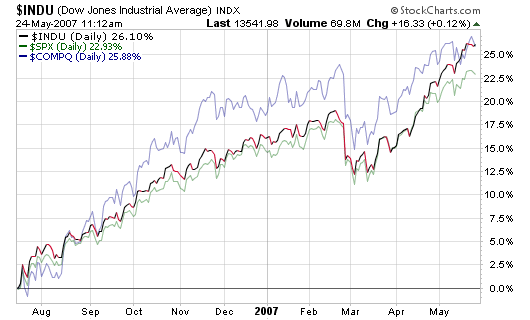
Looking at this first chart, we can see that the three major indexes are all up more than 20% in less than a year. I don’t see a sell signal by looking at this chart and actually like the fact that the market did take a breather in late February and March of 2007. I am not one to sell for the sake of selling but I do keep an eye on this performance chart to make sure the up-trend doesn’t extend too far without a natural pullback.

052407_market_perf.png

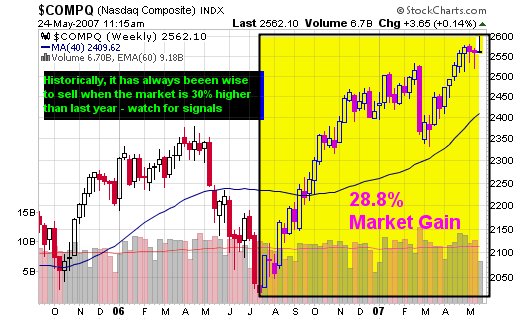
The second chart shows the NASDAQ reaching a 28% gain over a year ago which has signaled tops in the past. Eugene D. Brody, from Oppenheimer Capital, was quoted as saying: “Sell stocks whenever the market is 30% higher over a year ago”. Again, don’t sell for the sake of selling but watch for signals and major red flags. Maybe you should place physical stops instead of mental stops as we approach the quiet summer months.

052407_nas_per.png

Historically, June and July have been good months in pre-election years but August is usually a poor performing month according to the Stock Trader’s Almanac. Price and volume will be the ultimate barometer of the market’s condition so keep all of these things in mind but never act unless the market sends a true signal and/or confirms your beliefs.

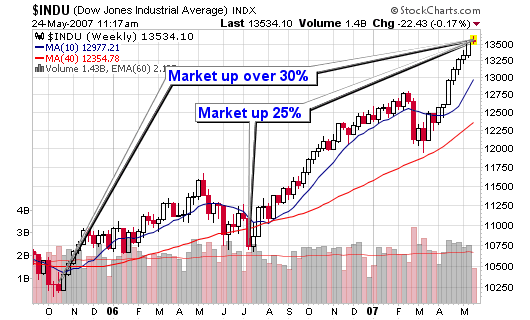
This final image displays the weekly chart for the Dow Jones Industrial Average which has gained 30% since October 2005 and 25% since last summer. We had a brief pause in the up-trend in the summer of 2006 and then again in March of 2007 but other than that, the index has been phenomenal while setting multiple all-time highs. We are now extended from both the 50-d moving average and the 200-d moving average so look to these areas as support or violation signals. The 200-d moving average carries more weight in determining if a trend is about to reverse.

052407_dow_per.png

Keep this quote in mind when looking for tops and bottoms:
“You try to be greedy when others are fearful, and fearful when others are geedy”
- Warren Buffett.

When the crowd gets greedy, the top is just around the corner and I don’t think we are there just yet! Ride the trend until it ends and don’t try to predict the top.

Cash America (CSH)

Stock of the Day
Cash America Intl. Inc.
Wednesday’s Intra-day Price: CSH - $43.09

Sector: Financials
Industry: Consumer Finance
Next Earnings: 7/26/07
52-week Price: $28.76 - $47.98

My Take:
To start, I have one issue with this stock and company in general: they make consumer loans so earnings could slide drastically if the economy takes a big hit later in the year. However, a sustained bull rally should benefit the stock allowing it to continue its uptrend, especially since it has a large institutional following. If institutions bail, this stock can fall quickly and will hurt investors along the way. For that reason, I am raising the risk factor for accumulating shares at this point in time.

052307_csh_wkly.png

The company owns and operates pawnshops in the U.S. and provides pawn loans, and short-term cash advances, and check cashing and other specialty financial services to individuals. These services will be needed whether we are in an up or down economic cycle but the company runs the risk of defaulting loans if the economy tanks and unemployment rises; leading to loans that can’t be repaid.

Recent chart action shows support at both the 50-d and 200-d moving averages with volume increasing above average levels. The stock must cross back above $44.50 in order to establish a recent new high above the last peak. If it fails, cut the stock and move on as the rally could be done.

Looking at the weekly chart, the stock must rise above the dotted down-trend line I have placed on the chart. It is very important for the stock to rise above this line in order to continue the long term up-trend. Gauge the volume to understand if institutions are driving the price higher or dropping shares.

Potential Trade Set-up:
Ideal Entry: $41 to $42 (we will use $42)
Risk is set at 1.0% maximum of total portfolio or $1,000 of $100k
Stop Loss is 5% or $39.90
Number of Shares: 475
Position Size is $20,000
Risk is $2.10
Target is $46-$49
Risk-to-Reward at $46 is 2-to-1
Risk-to-Reward at $49 is 3-to-1+

Strong Sister Stocks:
MasterCard Inc. (MA)
CBOT Holdings Inc. (BOT)
Alliance Data Sys Corp. (ADS)
Intercontinentalexchange (ICE)
Total System Services (TSS)

Institutional Analysis:
Held by Institutions: 89.13%
Money Market: 193
Mutual Fund: 293
Other: 13

Read more »

The Kirk Report: Blogs I Read

I want to thank Charles Kirk over at the Kirk Report for listing my blog as one of his “Blogs I read”.

What’s the big deal?

Well, his blog is viewed by many as one of the best on the web and I tend to agree. We use similar techniques as far as fundamental and technical analysis is concerned but he trades for a living and I am not quite there, yet!

Take the time to check out his blog and view the results of his portfolio over the past several years. It’s worth your time.

A few of the Accolades his blog has received:

  • Barron’s: Interview (April 2006)
  • Stocks & Commodities Magazine: Websites For Traders (March 2005)
  • Barron’s: Favorite Financial Blog (October & November 2004)
  • Kiplinger’s Magazine: Must-Read Blogger (October 2006)
  • Forbes: Best Of The Web Picks (December 2004 & 2005)
  • American Association of Individual Investors: Must-See Website (March 2005)
  • BusinessWeek: Recommended Blogs (July 2005)
  • MSN Money: Top Blogger (May 2006)
  • The Wall Street Journal: Popular Investment Blog (August 2005)

Next Page »