JADE Updated

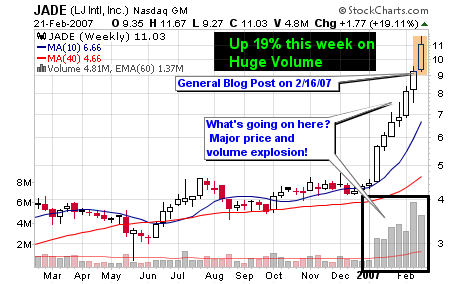
Said this on Friday about JADE in a post titled Bullion or Beef?:

As for JADE, it’s a lower priced stock that I typically steer clear of but I can’t ignore the huge surge in price and volume over the past several weeks. The stock had doubled in price on volume 3-6 sixes greater than the average. It looks extended to the average investor and I am not jumping on at this point because the fundamentals don’t support the position but I am interested if the stock consolidates and offers an entry area. A stock with this much interest is going somewhere based off of some type of news or hype. I don’t know what it is at this time but that is not important.

A solid 19% gain this week on huge volume (2 days of trading). Again, I don’t own the stock for reasons explained but someone is accumulating on heavy volume and that interests me.
022207_jade_weekly_sm.png

I don’t view the stock as a longer term investment at this time but I do see trade opportunities.
Intercontinental Education – The 20% Rule?

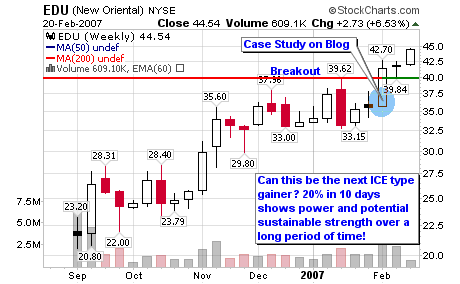
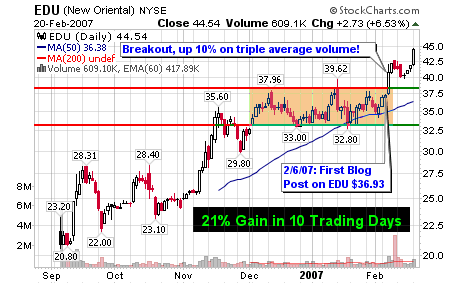
Do we have a new superstar in the making with the explosive 20% gain in ten days for New Oriental Education (EDU)?

022107_edu_daily_sm.png

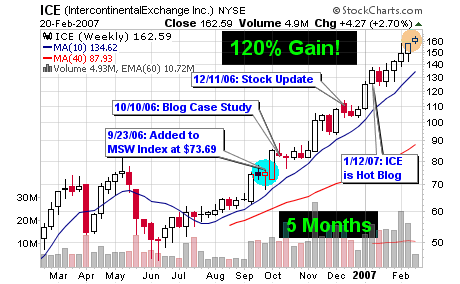
Intercontinental Exchange (ICE) blasted higher by 20% or so back in late September and early October of last year before consolidating for five weeks. I wrote a detailed case study on the exchange stocks at this time (ICE, ISE and BOT). So far, ICE and BOT have worked while ISE is struggling but gaining some support along the 200-day moving average in recent weeks.

William O’Neil of Investor’s Business Daily suggests holding a stock for at least eight more weeks if it gains 20% or more this quickly. If you held ICE, you would now have a 120% gain in five months and it all started with that quick 20% weekly gain.

022107_ice_weekly_sm.png

EDU was my stock of the day a couple weeks back and has leaped higher by 21% in two weeks. Is this a sign of things to come or just a quick buck that needs to be realized? Whatever the case, set a retracement stop and ride the trend to new highs. Institutional sponsorship is amazing as highlighted in this case study:

Learning about New Oriental Education (EDU) 2/6/07.

Someone is accumulating shares and I want to take the ride with them (I’m the small guy holding on for dear life). If the ride stops, I’ll jump off and move on to the next ride!

022107_edu_weekly_sm.png

EDU Institutional Numbers:
Shares Bought last Period: 6,313,271
Shares Sold last Period: 22,600
Value of Shares Bought: $227,073,203
Value of Shares Sold: $770,637

Additional related Links:
EDU Breakout on Huge Volume! 2/7/07

Intercontinental Exchange (ICE) is HOT 1/12/07

ICE, BOT and ISE Updated 12/11/06

Exchange Stocks: ISE w/ ICE & BOT 10/10/06

What is MSW?

I run this blog as an extension from my equity research business that resides at MarketStockWatch.com. The business originates from my own personal research and also provides an additional stream of income for me and my family. It’s not my sole source of income or the largest income but it does well and I love every second of teaching. Believe it or not, teaching and running a real-time portfolio actually makes me a better investor as I must be completely honest with myself and my rules. I am not shy to admit that I run the site as a profitable business as I don’t trade for a living at this time. I aspire to trade for a living as some point in my life but for now, I trade for capital appreciation. In other words: to build wealth (my net worth).

021607_index_shot1.png

I have been (trend) trading for ten years and love every second of the challenge and don’t mind if I don’t ever do it for a living. I am an entrepreneur at heart with interests in business, trading, real estate and education and I understand and prefer multiple streams of income to support my family. Trading for a living would need my undivided attention and I not ready to do that at this time. My main focus and goal in life is to stay out of the “rat race” or the so-called 9-to-5 job that I can’t stand. Time is more valuable to me than money and a job exchanges time for money so I understand that this path limits my freedom and monetary success. Therefore, I invest to increase my net worth, I run a profitable business that I started from nothing, I consult full time within the big builder industry and I own some real estate. I am by no means a real estate investor but I also have some aspirations to run a small business that buys distressed properties and hires a crew to restore the structure and sell it for a profit (that’s the architect in me speaking). I won’t get my hands dirty because that would just be another job; I envision myself as the business brains behind the operation.

021607_index_shot2.png

Anyway (I’m getting off on a rant)…

I wanted to share with all the readers of this blog what I do over at MarketStockWatch.com. Yes, this is a plug so stop reading if you are not interested!

My research breaks down into several categories and sections throughout the week.

The MSW Index is the official “Watch List” of MarketStockWatch and serves as the main list to select buying and selling opportunities. Daily screens are the tool that gathers stocks during the week in order to add the best candidates to the MSW Index. From there, all stocks with potential money making opportunities will be purchased into the MSW portfolio. The MSW portfolio will highlight several key factors that all investors should be tracking when buying and/or sell securities.

An example MSW Index is located through this PDF link.

An example Weekly Analysis is located through this PDF link.

021607_portfolio_shot1.png

A sample MSW Portfolio Spreadsheet is located through this link. It’s a fully interactive spreadsheet that incorporates my position sizing calculator, sell stops, target prices, R-calculations that help determine the risk-to-reward ratio and other key factors. Download it for free and modify it to use for your own trading portfolio.

The most viewed page from this blog is the position sizing spreadsheet and I would be willing to bet that this will be the second most downloaded spreadsheet heading into the future.

The Daily Screens:
This screen looks for new stocks making strong moves during the trading week with the types of characteristics that are explained on the Buying Strategy Page. A stock can be purchased from the daily screen but the MSW strategy is to look at these stocks further and allow them to prove their strength by watching them form patterns and entry opportunities on the MSW Index. These screens will take place on Monday, Tuesday and Thursday of each week. General market analysis on the major market indexes may be given during daily screens along with major emphasis on the strongest industries and sectors of the day.

021607_portfolio_shot2.png

The Weekly Screens:
The weekly screens will highlight the action among the major market indexes, the top performing sectors and/or industry groups from the previous week and the underlying trends in the market. The New High – New Low Ratio will also be highlighted during the weekly screen with key 52-week highs and lows. Changes to the MSW Index and the MSW Portfolio will be highlighted on the weekly screen. Links to the MSW Index and the MSW Portfolio will be located at the bottom of the screen. This screen will take place one time per week and will be uploaded no later than Sunday of each week.

The MSW Index:
This tool will be presented in PDF format and will focus on the strongest stocks from the daily screens; the stocks that make it onto the MSW Index will be analyzed deeper on both a fundamental and technical basis. This Index will look at things such as current price, support, resistance, buy-hold-sell ratings, target entry areas, stop loss areas, target gain and percentage gain on the MSW Index (general idea of trend). The MSW Index will also be the central place for detailed analysis on each stock that makes it to this level. The MSW Index will be offered each week at the same time as the weekly screen.

The MSW Portfolio:
The MSW Portfolio is a list of stocks that have been virtually bought and sold by MSW in 2007. Each stock has been bought or sold using the basic rules stated on the buying strategy page and employ the position sizing and risk techniques explained on this blog. This portfolio will give the community an idea of how I actually buy and sell stocks myself and how I perform against the major market averages and similar equity research services on the web. The MSW Portfolio includes key areas such as ticker, date bought, share price, portfolio size, percentage of portfolio risked, total dollars risked, stop loss in percent, position size, number of shares bought, 1-R risk, actual stop loss in price, target price, risk ratio, date sold, percentage gain/loss and notes on the entire transaction. (please view the upload example images in this post).

021607_portfolio_shot3.png

MSW Charts Page:
This page will house annotated stocks that are located on the MSW Index and the MSW Portfolio. This page can and will be updated on a weekly basis with key information located directly on the charts. The charts page will also have additional charts for the major market indexes, commodities, sector performances and other important technical screen shots.

The chrisperruna.com Blog:
The blog will serve as my platform to explain in further detail how I trade. It will cover the rules, the systems and learning experiences during my trading career. The blog will cover topics related to the stock market, success in life and anything I feel is important to talk about. I will highlight “stocks of the day” every week and will perform case studies that will focus on what I did right or wrong after a transaction has been closed on the MSW portfolio. The blog will be filled with colorful charts that will help everyone become a better trader – it’s the ultimate real time teaching and learning tool.

So that’s it. Enjoy the example MSW Index from earlier this year and the latest portfolio spreadsheet!

Bullion or Beef?

Stocks of the Day: BKC & JADE
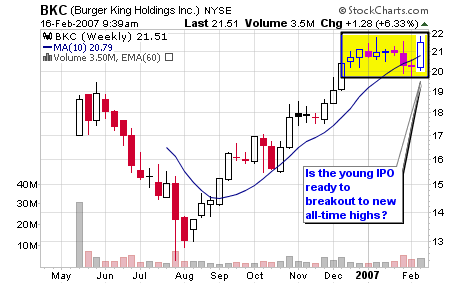
Two interesting stocks appeared on my research screens last night for MSW. One stock is being accumulated on heavy price and volume action while the other is a young IPO that looks ready to breakout to new all-time highs. One stock is a household name and has been around for more than 50 years while the other stock in basically unknown from Hong Kong.

Our beef stock (if we can call it that), Burger King Holdings, Inc. (BKC), through its subsidiary, Burger King Corporation, engages in the franchising and operation of fast food hamburger restaurants. Burger King also offers soft drinks and other food items. As of August 23, 2006, it operated approximately 11,000 restaurants in 65 countries worldwide. The company was founded in 1954 and is headquartered in Miami, Florida.

021607_bkc.png

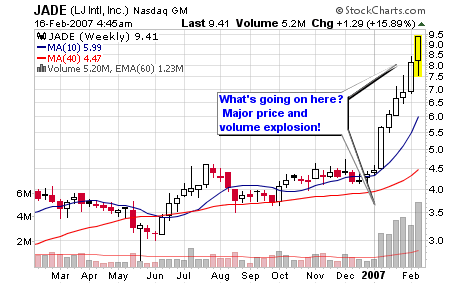
Not quite bullion but LJ International, Inc (JADE) engages in designing, branding, manufacturing, marketing, and distributing fine jewelry. The company specializes in the semiprecious jewelry, as well as offers pieces set in yellow gold, white gold, platinum, or sterling silver and adorned with semiprecious stones, diamonds, pearls, and precious stones. Its product line includes earrings, necklaces, pendants, rings, and bracelets. The company distributes its products principally to fine jewelers, department stores, national jewelry chains, and electronic and specialty retailers throughout North America and Western Europe, as well as in Japan and the People’s Republic of China. LJ International was founded in 1987 and is based in Hung Hom, Hong Kong.

021607_jade.png

Neither stock is the greatest in the world but they are both interesting based solely on their current charts. BKC has been trading sideways over the past two months with strong price and volume action over the past week. A move to new highs (all-time) on above average volume would be positive and signals an ideal entry opportunity. The fundamentals are what they are: average.

As for JADE, it’s a lower priced stock that I typically steer clear of but I can’t ignore the huge surge in price and volume over the past several weeks. The stock had doubled in price on volume 3-6 sixes greater than the average. It looks extended to the average investor and I am not jumping on at this point because the fundamentals don’t support the position but I am interested if the stock consolidates and offers an entry area. A stock with this much interest is going somewhere based off of some type of news or hype. I don’t know what it is at this time but that is not important.

021607_lorenzo.png

JADE – Institutional Numbers:
Held by Institutions: 4%
Money Market: 9
Mutual Fund: 3
Other: 1

Top Holder: Portolan Capital Management, LLC
300k Shares for 0.32% of Portfolio
Total Equity Value of Portfolio: $281.0 million

A few Fundamental Numbers:
Market Cap.: $175mm
Outstanding Shares: 18.94mm
Short Ratio: 1.8
Operating Margin: 7.29%
Net Income $M: 87.98
ROA (%): 4.49%
ROE (%): 9.45%
P/E (TTM): 35.4
P/E (Forward): 23.12

Earnings:
Yearly (2006): 0.28E
Yearly (2005): 0.21
Yearly (2004): 0.22
Yearly (2003): 0.19
Yearly (2002): (0.90)

Revenue (millions):
Yearly (2005): 94.6
Yearly (2004): 77.4
Yearly (2003): 58.2
Yearly (2002): 39.2

Net Income:
2005: 3.06
2004: 2.69
2003: 1.81

BKC – Institutional Numbers:
Held by Institutions: 64.4%
Money Market: 68
Mutual Fund: 63
Other: 6

021607_king.jpg

Top Holder: Goldman Sachs Group Inc.
32mm Shares for 0.02% of Portfolio
Total Equity Value of Portfolio: $193.0 billion

A few Fundamental Numbers:
Market Cap.: $2.88bb
Outstanding Shares: 133.89mm
Short Ratio: 5.0
Operating Margin: 9.10%
Profit Margin: 2.63%
Net Income $M: 27.0
ROA (%): 4.99%
ROE (%): 9.59%
P/E (TTM): 48.8
P/E (Forward): 17.44

Quarterly Earnings Growth (yoy): 40.70%
Quarterly Revenue Growth (yoy): 9.20%

Enjoy!

021607_whopper.jpg

The Importance of Timing the Market

With the great response to the article from earlier in the week, Don’t Forget about Past Trades , I would like to expand the conversation.

021407_sundial.jpg

Any investor can find and research the “greatest” stock on the market; one with huge potential but if the general indexes are negative, it will most likely be the wrong time to buy. A stock with accelerating earnings, rising sales, an up-trending chart pattern and a strong industry group may sound excellent to buy on the surface but will mean absolutely nothing if the market is positioned to move in the opposite direction of your expectations. As soon as a stock is purchased, the time comes for an investor to make a decision to hold or to sell. If the position shows a profit, hold as your judgment is correct. If the position shows a loss, cut it quickly and don’t rationalize the situation before the loss doubles in size. Timing will play an important role in determining if you are right or wrong.

Losers must be cut quickly, long before they materialize into enormous financial disasters. The company and underlying stock may not be a loser but rather your timing may be premature to a strong movement, forcing you to sell on a pullback. After a stock is cut from your portfolio, the transaction must be forgotten about and eliminated from your subconscious mind and/or emotional bank. This may sound as if I am contradicting myself from Monday but I am not. I said the transaction must be eliminated from your memory bank but not the actual trade.

The trade must be studied to capture the true essence of your mistake but the specific security involved must be blocked from any sentimental attachments, allowing you to consider re-establishing the position at another level (most likely higher). This repurchase may take place immediately or well into the future but the important fact is that you were wrong with the timing on the initial position. The timing, also known as the ‘M’ in CANSLIM by William O’Neil, may have been wrong even though all fundamental and technical criteria related to the individual stock seemed to be perfect.

A quote from the great Gerald Loeb:
“Cutting losses is the one and only rule of the markets that can be taught with the assurance that it is always the correct thing to do.”

The wisdom shared by Loeb is easier said than done. Humans like to take profits and hate taking losses or admitting that they were wrong. Pride and ego distorts the clear thinking process that every investor must posses when following clear cut rules that provide insurance to their cash stake. Even tougher, humans refuse to repurchase anything at a higher price that they sold it previously. We are trained from childhood that sales and discounts are they way to make sound purchases. GARBAGE – buy value and opportunity, even if you pay a higher price as long as the risk-to-reward setup is reasonable. As Loeb states, only logic, reason, information and experience can be listened to if failure is to be avoided.

It is advisable to make a “test buy” in a shaky or unstable market which allows the investor to assess the general conditions with minimal risk but still maintain an emotional attachment. If the position goes bad, a small loss will be realize but the damages will be limited and the investor’s pride and ego can be repaired rather quickly. In a sense, the investor was half right by only initiating a partial position also known as a “test buy”. If the market was trending up, a “test buy” would not have to be established as the market direction would have been clear from the beginning.

021407_clock.jpg

When it comes to timing, an uneducated investor may realize better gains during a solid bull market based on pure luck than a seasoned investor will return in a sideways or unstable market. Following the trend will be the most successful route to consistent profits over the long haul. By watching the general market indicators, such as price, volume and daily new highs (NH-NL ratio), an investor should know exactly what type of environment they are trading. The most important factor weighing on the stock market is the presence of public psychology, even more so than any fundamentals that the most intelligent academic analyst can compute. Technical analysis along with confirmation of the market trend allows us to see the combined thought process of the general public and tells us if the timing is right to buy or short a specific stock, regardless of the fundamentals.

In conclusion, we must understand that certain situations are only applicable during specific times. Buying leading stocks during a down trend is a sure way to multiple losses that are cut quickly. Shorting stocks during a raging bull is another sure way to financial disaster and margin calls. Don’t get discouraged if you take a few small losses consecutively as your rules and portfolio are telling you to stay out of the market at this time (with this strategy). The timing may be off even though the stock and research is favorable. Why would you swim upstream to reach your destination if you could jump in a boat and row downstream with the current another day? Before you ever start to immerse yourself into researching a stock to purchase, make sure you know the exact environment of the market and determine if it coincides with your objective. If it doesn’t, get ready to get slaughtered, especially if you don’t follow strict rules to cut all losses quickly.