Archives for March 2008

On Vacation until Sunday April 6

I will be taking off the next two weeks as I travel to the the Riviera Maya.
My vacation has begun if you haven’t already noticed – sorry for the delay in getting this information out.

Please take the time to check out some of my most popular and informative blog articles from the past 12-15 months (below).
I also recommend that you select a book from my “best of” library and read it while I am away (scroll down on this page).

Regular posting will return on Monday, April 7, 2008

I will be reading Microtrends and The Art of War while relaxing on the beach.

A look back at some of high quality educational articles from 2007

January

February

March

April

May

June

July

August

September

October

November

December

Top 20 chrisperruna.com Posts

Start with these books and then scroll down to view my Stock Market Library:

An Excellent Stock Market Gift List:

Learning about Stocks (Fundamental and Technical Principles):

System Development and Market Psychology:

Great All-around Reads:

All Others:

Weekend Must Read Links 3-21-08

The markets are closed today so chew on the excellent links below or read the top 20 posts on this site.

011008_absolut_links.png

Absolut Must Read Links for Friday, March 21, 2008:

Cramer’s TheStreet.com Sneaky?

I start by giving a hat tip to Don Harrold from DonHarrold.net for providing the in-depth research and video highlighting the Cramer BS! And that’s what it is, BullSh*t!

The second hat tip goes to Adam from Daily Options Report who uploaded the YouTube video to his site, where I first viewed it.

Watch the video and understand what TheStreet.com is doing here. I mean, all credibility goes out the door if this is true and the image is not altered.

How many other lousy, losing stock picks does TheStreet.com erase from their website without anyone noticing? Do they really go back and toss out poor stock picks without telling the public? They should lose ALL journalistic credibility and ALL equity research credibility (if they had any to begin with).

I am glad people like Don Harrold keep an eye on the big guys because so many sheep do watch these shows and trade based off of what they say.

The second beef I have is the fact that Jim Cramer claims he was talking about Bear Stearns, the bank, and not the stock (BSC). Maybe he was because he does refer to the “liquidity” based on the caller’s question but I still have reservations.

I am wondering why a stock chart was uploaded on the screen if he was talking about Bear Stearns the bank and not the stock; they post these charts on the screen with every other stock analyzed.

Why too, did Jim forget to say the words “common stock” during the initial telecast? Let me guess: because he was talking about the stock just as he has been calling it a buy since last summer (the start of the big crash). The follow-up video of Cramer stresses the words “common stock” but he forgot to iterate this during the initial telecast. He has to be clearer considering he is speaking to an audience that takes his words at face value.

Anyway, I am wondering why the mainstream media or even competitors such as the Fox Business Network (or whatever it is called – I don’t watch these channels) isn’t calling out TheStreet.com and/ or Cramer.

I try not to be a Cramer basher but he’s such an easy target when he does stuff like this and his company does something so despicable. I leave the day-to-day nit-picking and bashing for others but I have to jump in and make it clear when something is very wrong (and involves a public company). I mean, I almost worked for TheStreet.com and Jim Cramer (I made it several rounds deep in the interviewing process to become a part of their equity research team). Fortunately for me, they went with the business school lad instead of the architecture grad.

[Read more…]

Follow-through Head Fake

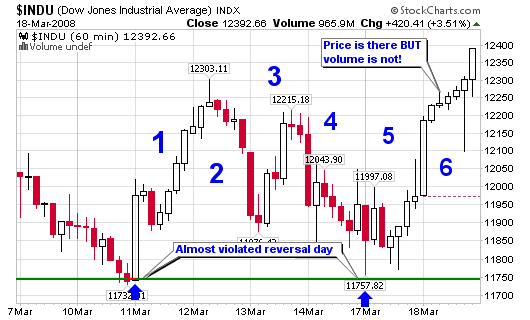
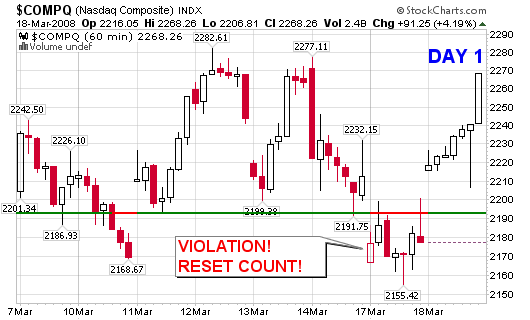
Advancers lead decliners by a 17-to-1 ratio on the NYSE Tuesday and 10-to-3 on the NASDAQ. The DOW was up 3.5% with the NASDAQ up 4.2% making it seem like we had a follow-through but volume was lower. Besides, the NASDAQ violated the reversal range intraday on Friday and then again this past Monday. Because of this violation, the count had already reset and Tuesday’s huge gain acts as day 1 for a new rally. I know this can be confusing but it makes sense after you study the rules and then watch it happen over several years.

We can’t call this a follow-through on day 6 for the DOW because trading volume dipped from yesterday’s totals. The count does not reset because we have not violated the intraday low from the reversal day or day 1 of the rally attempt. Leading stocks didn’t do much to lift the market today so it is better off that we didn’t have a suspect follow-through. Rebounding financial stocks lead the market higher, not something we can hang out hats on.

Read up on the CANSLIM rules if you don’t completely follow what I am talking about when it comes to reversals, rallies and follow-throughs.

031808_dow_daily.png

031808_nasdaq_daily.png

Past CANSLIM Articles:

VISA (V) set to Launch

Visa Inc. (V) is set to launch the largest initial public offering in U.S. history on Wednesday but I doubt it will do much to help this market (from a bullish standpoint). The company is offering 406 million shares with an anticipated price between $37 and $42, according to SEC filings.

In total, the IPO could raise nearly $17 billion, surpassing the record held by the AT&T Wireless IPO from 2000 which raised $10.6 billion. The $15 to $17 billion projection is approximately 70% higher than what the market was reporting when I was anticipating this IPO last November.

“VISA, the largest U.S. credit card network said it is looking to raise $1o billion in an initial public offering, according to a registration statement with the SEC.”

JPMorgan (JPM) is one of the lead underwriters (Goldman Sachs is the other) so the market wants this IPO to launch successfully so additional fears don’t rise following the $2 Bear Stearns fire sale. A successful IPO would generate a large cash influx to banks such as JPMorgan, Bank of America and Citigroup. Visa’s IPO could generate around $500 million in fees for underwriters, according to documents with the SEC.

Shares will price after the close Tuesday with lots ready to move Wednesday morning.

As pointed out in my last post, Visa and Mastercard (MA) are not directly exposed to rising defaults and late-paying consumers because they process transactions and these transactions typically rise when credit is tight from banks. American Express and Discover are not as fortunate in this sense as they extend the credit to their card holders, exposing themselves to the defaults.

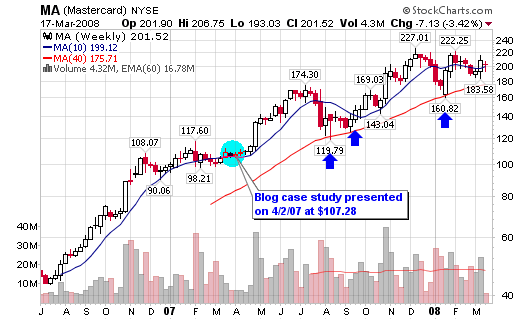
As you can see, Mastercard (MA) has held up very well during this credit crisis. It has not violated it’s major moving averages and is still in an overall long term up-trend.

031708_ma_wkly.png

November 15, 2007: Anticipating the VISA IPO

Why do I like VISA’s potential?

  • $1o Billion would represent the second largest IPO ever!
  • Revenues are expected to grow steadily as consumers continue to use their cards
  • VISA processed 44 billion transactions totaling $3.2 trillion in 2006 (Mastercard processed 23.4 billion transactions totaling $1.9 trillion)
  • VISA has made $771 million on $3.7 billion in revenue during the first nine months of 2007
  • VISA makes their money from the fees it charges to card users and merchants using its network
  • Mastercard is half the size of VISA and is up 5-fold from its IPO

BEST OF ALL:

  • Because it acts as an intermediary, Visa doesn’t sustain losses when consumers don’t repay the debts run up on credit cards bearing its brand. Those liabilities instead fall to the banks that issue the cards and set the terms of repayment
  • Most of Visa’s major stockholders are banks. They include: J.P. Morgan Chase & Co., which owns 23.3 percent of the company’s Class B Stock; Bank of America Corp., 11.5 percent; National City Corp., 8 percent; Citigroup Inc., 5.5 percent; U.S. Bancorp, 5.1 percent; and Wells Fargo & Co., 5.1 percent.

NO RISK for VISA; the banks are responsible for the cardholders that don’t pay their bills. What could be better than that? Tell me!